
|
I had left Fort Pitt for Battleford only a day or two when the Wood Crees came in from Lac des Isles and surrendered. It was dark when they arrived, and that strange man, the Wandering Spirit, was with them. Evidently, the war chief saw only death ahead of him. Their lodges were pitched, and the evening meal was over. Wandering Spirit came to the door of his lodge and called: "All who wish to look on me once more, come now!" He went back, dropped on a blanket, and sat staring gloomily into the fire. Half an hour passed. He jumped to his feet, his hand snatched at his waist and flung out clutching his long sheath knife, the blade struck deep into his side and he fell to the ground. The war chief's aim was bad. He missed his heart but cut the lung so that a lobe protruded. His time was not yet. Yes, a strange man, this war chief; suspicious yet no coward; capable of any devilry when the passions of the savage held sway, yet kind and gentle to his family and to others in calmer moods; a slayer of defenceless men, yet daring to recklessness on the battlefield, with a record off many Blackfoot scalps. In the end sacrificing himself as an atonement for the rest of his band. That he did not succeed was an accident. "Once a priest always a priest, once a Mason always a Mason, but once a journalist always and forever a journalist," says Rudyard Kipling. For journalists, he might have substituted traders. No sooner was I well out of the clutches of the savages, vowing I never again wanted to see an Indian, than I was ready to go back among them. There is a charm about the red man, with his paint, his feathers, his simplicity, his native eloquence, his irresponsibility - even his dirt, and in the smoke of his campfires, the crossed and blackened poles of his shifting habitation, the sweep and majesty of his virgin land - something in all this that gets into the blood of his white-skinned brother and sticks there. It lures him away from the conventionalities, the set and fretting boundaries of civilized life, back toward the beginning of things when Nimrod was a mighty hunter before the Lord and all men were shepherds. There were dollars and furs, bead, silk and feather work, among the Indians who had come in and surrendered at Fort Pitt and I wanted a share of it all. Besides, there was the pay of the troops themselves left at the old fort. Therefore - I think before I was actually altogether aware of it - I found myself absorbed in the business of selecting an outfit. This is not quite as easy as it sounds, unless you know Indians - their likes, their dislikes, their needs, what will interest them and what won't. These things I happened to know. There were blankets and prints, syrup, tobacco, vermilion in little deerskin bags, butter, canned fruits, and many other articles dear to the aboriginal heart and stomach, including ginger ale and cigars. I met Poirier and engaged him with his team to haul the stuff to Pitt, and I took Henry Quinn to help me deal it out. Then we hit the trail and in four days from Battleford were in Pitt again. We crossed the broad Saskatchewan with some difficulty, pitched our tents near the headquarters of the commanding officer on the hill above the ruins of the old fort and spread out wares in readiness for business. Sentries about the Indian camp a few hundred yards back guarded the surrendered hostiles. I had been told by a trader who had preceded us to Pitt, having come upriver by steamer, that I might as well return without unpacking. He had been there a week and had sold practically nothing. I did not accept his advice. Only a few of the Indians were permitted to leave their camp at a time, yet during the first two days I picked up both furs and fancy work and paper dollars as well. They came with their valuables concealed under their blankets, for the soldiers had a way of accepting anything portable belonging to their charges without any "by your leave." The third morning after our arrival Colonel Osborne Smith, who had been left by General Middleton to receive the surrender of the hostiles, sent word to the Indian camp that all the men were to march with their arms to the open space between the two camps, as he had something to say to them. An hour later they arrived in a body. The Winnipeg Light Infantry in scarlet tunics were drawn up in line to receive them. The Indians were told to stack their guns at a spot designated and to take seats in a half-circle on the ground some distance off. 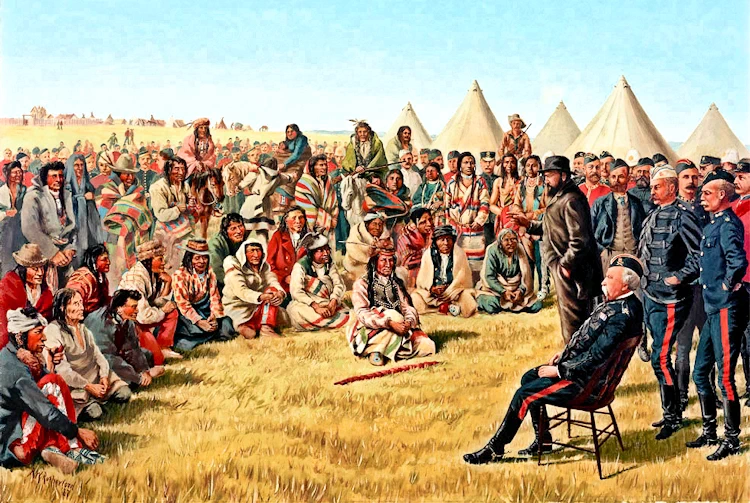
Colonel Smith spoke. He told them they had been guilty of grave wrong in taking up arms against the Great Mother, but that the heart of the Great Mother was kind and most of them would be forgiven. There were some, however, who had killed defenceless white men, burned buildings and committed other serious offences. These the Great Mother had ordered him to take with him to Battleford. The Great Mother would say later what should be done with them. He would call out the names of those who were wanted and they must step out and take seats together, apart from the others. He read my deposition and the interpreter called the names of the murderers - Walking the Sky, Manichoos, Napaise - with those of minor offenders between. He called the name of Apischiskoos. I saw the face of the man who had struck the priest in the eye with the butt of his riding whip and chased on horseback and shot down a poor fugitive, take on a ghastly smile as he rose and walked to the doomed group of his fellows. 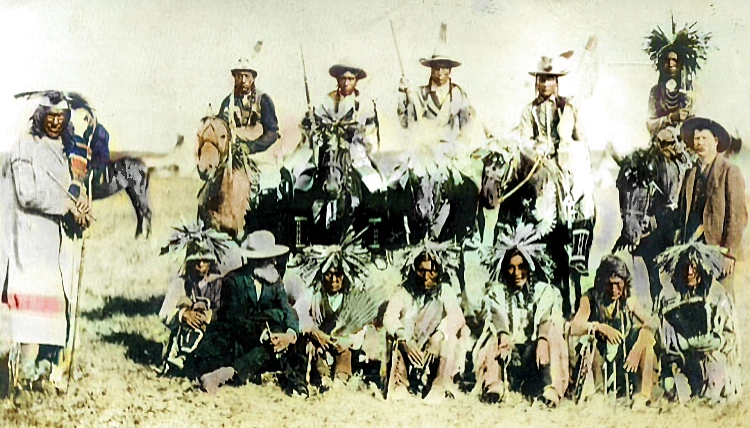
Wandering Spirit, Miserable Man, Walking the Sky, Apischikoos and Napaise. When the chief criminals had been taken the redcoats stepped between them and the remainder and they were marched down to the old fort to await the departure of the boat which should carry them to Battleford and judgment. Then the others were told not to forget the mercy of the Great Mother, for many were almost equally guilty. They could return to their reservations but they would not be trusted with their arms. They would be cared for if they were good for the future, as they had been looked after before the trouble, and now they might return to their lodges. Wandering Spirit was ill in the camp, Miserable Man was a fugitive, and Kaweechetwaymot was dead. Trade was not so brisk as I wished, for many of the Indians whom I knew possessed barterable effects would not leave their camp at all. Late in the afternoon, therefore, I. secured from Colonel Smith to the sentry on duty at the bridge between the camps an order to pass me with a wagon into the Indian encampment. It was stipulated that I was not to remain longer than an hour. However, that did not matter. Loading the remaining stock into the wagon, we drove over. In a few minutes, our open-air shop was surrounded. Men, women and children handed up dollar notes, beaver skins and fancy moccasins at such a rate that I was kept busy receiving them and had to call to my assistance in dealing out the goods a couple of the more intelligent of the Indians. Notwithstanding the time limit, I was in no hurry to leave, and when darkness came, as it soon did, I drove over among the lodges, put up a small tent and stowed what little stock remained away in it. I had got most of the Indians' saleable property, but up until eleven o'clock that night the odd one dropped in with another dollar bill to make a small purchase and we smoked and talked about "the things that were" and those that were to come. I was leaving these poor people, these children of the wilderness, with all their good and bad traits - their ready and generous hospitality for long years to the white man wherever met, until evil counsels and the white man's own cupidity and looseness and contempt brought disease and destitution into their midst and turned their hands against himself. Many of them had been my companions on lonely trails. Some had faced danger and death to defend me. Most of them had been my friends when God knows if ever I had need of friends. I was leaving them probably never to come again amongst them, and I was truly sad. Before turning into my blankets I walked over to the lodge of an Indian whom I had known well. He had been arrested that day for some minor offence, but his wife and brother-in-law were there. She was a woman who would have been thought pretty even among civilized peoples. She had a face like one of Gibson's women - a rather thin face with graceful lines and deep intelligent eyes. Her black hair was fine and lustrous and she had the bright coquettish ways of those women always so dangerous to men. Once a white man had fallen in love with her and her husband had gone to the white man's house in the night and tried to kill him. The white man had been sent out by the government to teach the Indians how to farm and raise stock. I talked to the woman, telling her that her husband would soon be free again. In comparison with what others had done, he was unspotted. It had grown very still, except that in a lodge nearby some women wailed dismally. I asked her whose it was. "Apischiskoos's," she replied. His wife and his two pretty daughters, just budding into the hopeless Indian womanhood, would never see him again. The next morning the Indians still discovered means to buy and I stayed on in the camp. With the exception of Wandering Spirit the chief culprits had all been taken and later in the day those remaining at liberty would move out to Onion Lake. About nine o'clock I walked over to see Wandering Spirit. The war chief was a very sick man. He lay outside his lodge, screened from the sun by a blanket on poles above his head, his long curling hair resting on a pillow, his arms and chest bare except for the encircling bandage hiding his wound. He turned his deep black eyes as I came up - and listless they looked now, but as soon as he saw me the old fire flashed into them, the fierce blood surged into his face and made it dark as I had so often seen it do before when he was roused. Did he hate me to the last? I have often wondered. The excitement upset him in his weakness; he turned away in distress. I, his enemy, had come to taunt him, he thought, perhaps. I stood looking down at him for some moments. "Have you anything to trade?" I asked at length. "I am here with goods, but today I go again. Anything you want you must get now." He shook his head languidly. "No," he answered wearily, "I want nothing. Anyway, I have nothing with which to buy." He looked toward the lodge. "N'tanisl" His daughter came. He spoke with her in a low voice, then stretched out his hand to me with a ten-cent piece in it. "At least I have this. She will spend it with you." I looked at the wasted figure with its weak voice. Could this be the terrible man I had shrunk from on that appalling day at Frog Lake? - whom I had heard boast in the Grass Dance of the scalps he had taken? - who had ruled a camp of savages by the might and dread of his single arm and will? My heart was touched with a strange, unreasoning pity for him. I knew that this was a sentiment I had no imaginable excuse for entertaining, yet there it was, uninvited. "What are you living on?" I asked. "Nothing, almost nothing. The soldiers are good; they give us bacon and flour every day. But I do not care to eat." "Fat bacon and mouldy flour are no food for a sick man," I said. "Let your daughter come with me and I will send you things better for you. Where is the knife - the one you did this with?" I pointed to his wound. He sent and got it. His blood was still upon the blade. "I will keep this to remember you by," I said. He nodded assent and I went back to my camp. I gave his daughter jam, canned meat, tea, sugar, butter, and biscuit for my old enemy. He was carried on a stretcher to the steamboat, put aboard with the other prisoners, and that afternoon they went down the Saskatchewan to Battleford. The Indians struck their lodges and moved at noon for Onion Lake. Another boat was expected in a day or two from Edmonton and I decided to wait and return by her to Battleford. I sent Poirier back by trail and toward evening said to Quinn: "Let's go out and camp one more night among them. It will probably be the last. And I want to get Kahneepotay-tayo's dancing dress." A half-breed hired us horses and sitting that night with the Indians in their lodges we imagined ourselves once more out of the world we knew. I looked up the head dancer of Big Bear's band and gave him a fancy blanket for his dress. It was a silver-fox pelt, slit down the back and decorated with military brass buttons, plumes, bells and ribbons. He wore it thrown over his shoulders, the head resting on his chest and the splendid tail hanging down behind him. He had kept it carefully rolled up, and hidden away so that the troops should not get at it, but he thought he would not require it anymore. The next morning we rode back to Pitt, the steamer arrived in a day or two and we returned to Battleford. |
Questions - Comments?


Links to all jkcc.com Webpages:
| Ausland Lake |
Northern Saskatchewan
| Deep River Fur Farm |
| Deep River Trapping Page |
| Deep River Fishing Page |
| My Norwegian Roots |
| Aasland Farm, Norway |
| My Norwegian Family |
| Early Mink of People Canada |
E. Rendle Bowness
| The Manager's Tale |
Hugh McKay Ross
| Sakitawak Bi-Centennial |
200 Year History.
| Lost Land of the Caribou |
Ed Theriau
| A History of Buffalo Narrows |
| Hugh (Lefty) McLeod |
Bush Pilot
| George Greening |
Bush Pilot
| Timber Trails |
A History of Big River
| Joe Anstett, Trapper |
| Bill Windrum, Bush Pilot |
| Face the North Wind |
By Art Karas
| North to Cree Lake |
By Art Karas
| Look at the Past |
A History Dore Lake
| George Abbott |
A Family History
| These Are The Prairies |
| William A. A. Jay, Trapper |
| John Hedlund, Trapper |
| Deep River Photo Gallery |
| Cyril Mahoney, Trapper |
| Saskatchewan |
A Pictorial History
| Who's Who in furs |
1952 to 1956
| A Century in the Making |
A Big River History
| Wings Beyond Road's End |
| The Northern Trapper, 1923 |
| My Various Links Page |
| Ron Clancy, Author |
| Roman Catholic Church |
A History from 1849
| Frontier Characters - Ron Clancy |
| Northern Trader - Ron Clancy |
| Various Deep River Videos |
| How the Indians Used the Birch |
| The Great Fur Land |
| The Death of Albert Johnson |
| A Mink and Fish Story |
Buffalo Narrows
| Gold and Other Stories |
Berry Richards
| Saskatchewan James Carnegie |
| Ausland Lake |
Northern Saskatchewan
| Deep River Fur Farm |
| Deep River Trapping Page |
| Deep River Fishing Page |
| My Norwegian Roots |
| Aasland Farm, Norway |
| My Norwegian Family |
| Early Mink of People Canada |
E. Rendle Bowness
| The Manager's Tale |
Hugh McKay Ross
| Sakitawak Bi-Centennial |
200 Year History.
| Lost Land of the Caribou |
Ed Theriau
| A History of Buffalo Narrows |
| Hugh (Lefty) McLeod |
Bush Pilot
| George Greening |
Bush Pilot
| Timber Trails |
A History of Big River
| Joe Anstett, Trapper |
| Bill Windrum, Bush Pilot |
| Face the North Wind |
By Art Karas
| North to Cree Lake |
By Art Karas
| Look at the Past |
A History Dore Lake
| George Abbott |
A Family History
| These Are The Prairies |
| William A. A. Jay, Trapper |
| John Hedlund, Trapper |
| Deep River Photo Gallery |
| Cyril Mahoney, Trapper |
| Saskatchewan |
A Pictorial History
| Who's Who in furs |
1952 to 1956
| A Century in the Making |
A Big River History
| Wings Beyond Road's End |
| The Northern Trapper, 1923 |
| My Various Links Page |
| Ron Clancy, Author |
| Roman Catholic Church |
A History from 1849
| Frontier Characters - Ron Clancy |
| Northern Trader - Ron Clancy |
| Various Deep River Videos |
| How the Indians Used the Birch |
| The Great Fur Land |
| The Death of Albert Johnson |
| A Mink and Fish Story |
Buffalo Narrows
| Gold and Other Stories |
Berry Richards
| Saskatchewan James Carnegie |