
|
Captain Perry next morning outfitted me with a pair of riding breeches and other necessary clothing and assigned a horse for my exclusive use. Major Steele, with a party of scouts, was starting on Big Bear's trail. My request that I be allowed to accompany him was promptly vetoed by the general. I had already been exposed to sufficient danger, he said; the Indians would probably recognize me, in which event I would be singled out by them for special attention. He was glad, however, to enlist me as guide and scout to his column from Frenchman's Butte to the Beaver River, seventy miles to the north. 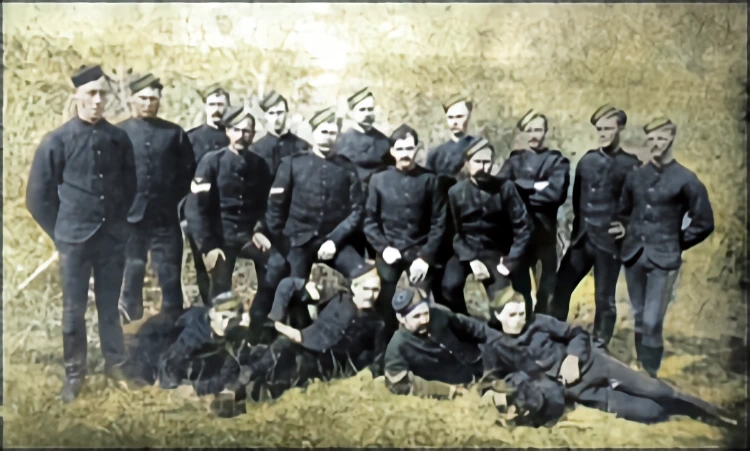
I spent the day in necessary rest and in preparation for my new duties. Wherever I went I was an object of immense interest to teamsters and volunteers. I am afraid I found much unholy satisfaction in trying to appear unconscious of this - I was pretty young. It was, I think, my first taste of fame - a dangerous thing that has turned older and wiser heads than mine. I believe I got over it, but it was pleasant while it lasted. If I spoke to a man, he thought himself signally honoured. One, a teamster, gave me a hat. General Middleton had arrived and gone over the ground of the Frenchman's Butte fight with General Strange. On June 4th at two in the morning, a courier arrived with word from Major Steele of an engagement at Loon Lake, fifty miles to the northeast, with Big Bear. General Strange had wished to go with some of Middleton's cavalry to the support of Steele. The commanding general, however, preferred to await a report from Steele. On June 4th, he decided he would himself follow the major with his cavalry and he ordered Strange north to the Beaver River to cut off Big Bear's retreat should the chief move in that direction. On June 6th General Strange moved out to Onion Lake. I rode, as a guide, at the head of the column. In the evening we came upon and killed two steers; the fresh meat made an acceptable variation from a monotonous diet of bacon, hard-tack and canned corned beef. The next night we camped on the banks of beautiful Frog Lake, and the following day saw us nearing the Chippewyan reservation at Beaver River. I was riding with the advance scouts fifteen miles ahead of the column. We crossed two heavy muskegs, dismounted, and leading our horses, the ground so soft they sank to the knees. The added weight of a rider might have sunk them permanently. Following us, the nine-pounder was dragged with ropes through these bogs by the infantry, the horses first detached and roads corduroyed across the nasty big moulds of quaking mud, grass and water. About three o'clock our advance party was cautiously approaching through the timber the Hudson's Bay Company's post at the Chippewyan reservation. When perhaps four hundred yards off, an Indian emerged from the main building, carrying a sack of flour. He wore a scarlet upper garment and I took him for one of Big Bear's men, who had secured a few police tunics left by Captain Dickens when he abandoned Fort Pitt. The Indian mounted his horse and rode away. Now we felt no urge to engage the whole of Big Bear's following. We were only four and there were three hundred of them. In open country, we should have had all outdoors to ride over. Here there was only one line of retreat - the trail - the country being thickly wooded. Also, the trail was crooked and the Indians might, by taking some shortcut unknown to us, head us off. We therefore moved quietly' back for a mile and, crossing a creek, tied our horses in the woods on the other side. Here we were able to watch the trail and reasonably certain the redskins could not outflank us. We boiled our tea kettle over a few sticks and sent a scout back fifteen miles to tell General Strange we had located the Indians. The sun was sinking when reinforcements, some forty men under Major Hatton, arrived. We moved ahead and near the post dismounted, left a few men with the horses and advanced rapidly in skirmishing order till we reached the open before the buildings; then broke into a run. But - we found no Indians. They had no doubt had a guard and seen us when we first sighted them. It was long after dark when General Strange came up and the balance of his command not until daybreak. We camped at the old trading post and the next morning with eight scouts I went on to the Beaver River, eight miles farther north. At the Roman Catholic mission, two miles from the river, we found a quantity of furs belonging to a half-breed rebel named Montour in Big Bear's camp. These we appropriated. It was like a circus, watching some of the fellows getting the packs on the backs of their horses. A white man's horse objects fiercely to the fur of any sort; a bearskin is his pet aversion. They snorted, bucked and kicked, trembling with fright, and then raced madly away with the flopping packs on their rumps adding frenzy to terror. But at length we all got safely aboard and rode away, to hide our plunder in the woods. At a hut on the banks of the river a mile or two east of the mission we found campfires recently abandoned and the offal of a slaughtered ox. Here we turned west and entering several of the houses on the reservation secured more good furs. The Chippewyans were rebels and the confiscation was therefore justified. We then struck a road leading through thick bush along the bank of a creek flowing into the river. In the soft mud, we came upon fresh moccasin tracks. That they had been made only a few minutes before was evident; the water pressed out of the black muck by the passing feet was still trickling back into the impressions they left. We went on slowly and cautiously, with a sharp lookout on either side of the trail, but saw no Indians. We descended the high bank and at the river's edge came upon a bark canoe, lately drawn up. A scout raised his foot and would have put his heavy boot through the bottom, but I stopped him. "Don't do that" I told him. "We might want the birch bark to cross the river." A hundred yards farther one we found a cache of furs under a small log shelter. It took us some time to divide, and turning back, what was our surprise to find the canoe gone. So close had we been behind the Indians that they had not dared touch the canoe, but had hidden at no distance from us, slipped out and crossed while we were busy with the furs. Had we accidentally stumbled upon them, some of us probably would have been killed. However, I expect there were not more than three or four Indians and they were no doubt glad to get out of a tight corner without a fight. Drawn upon the opposite bank lay the canoe. The fugitives, we knew, would be watching across the water. George Beatty, a Salteaux Indian, and myself, while the others filed up the hill, taking shelter behind large trees, remained to talk to the fleeing Chippewyans. "Come back!" we shouted in Cree. "Plenty of soldiers are behind us. They will follow you and you'll all be killed. After tomorrow night we will cross the river." Not a sound could we raise in response to our jibes and threats, so with a parting salute from our guns at the woods across we climbed the hill and returned to the mission, where the column had already arrived. Next evening, June 9th, the Chippewyans, who had left Big Bear after Frenchman's Butte, with Father Legoff, their priest, having crossed the Beaver from Cold Lake, six miles north, surrendered to General Strange. In the morning, Major Butler and I went to their lodges and ordered the men to bring their arms and march behind us to the general's camp, a mile away. The priest pleaded hard for his misguided flock, but unavailingly. They were disarmed and the ringleaders, among them my friend, Catfish, were arrested. A board of inquiry, at which the white prisoners testified, held them for trial. The next day with two other scouts I made the rounds of the reservation. Revolvers at full cock in our hands, we galloped up to each cabin in turn. We found no Indians, but we did discover and appropriate some prime beaver and bear skins. Those furs today would be worth some thousands of dollars, but, lest it is thought that I made a fortune out of the plunder, I may mention that the total value of all the furs I obtained, apart from what I gave away, was at that time one hundred and fifty dollars. June 24th we started with the remainder of the troops under General Middleton, whose pursuit of Big Bear had been blocked by impassable muskegs and who had joined us on the 14th, on the return to Fort Pitt. Arriving there I learned that Mrs. Gowanlock and Mrs. Delaney had been brought in by William McKay and a party of scouts; they had been found with some half-breeds who had withdrawn from Big Bear after Frenchman's Butte and were moving toward Fort Pitt. These half-breeds posed as loyal, but in the case of one of them, at least the fiction would not hold. This was Pierre Blondin, the man who - though as afterward developed, from no commendable motive - bought Mrs. Gowanlock from the Indians, who appeared before her in her deceased husband's overcoat and who wore all my best clothing in the camp. Poirier, whom I have mentioned before, was responsible for the half-breed's undoing. Blondin spoke good English. Some scouts had gathered around him one evening and were being entertained with a recital of his heroic acts when Poirier chanced to pass and caught some of his remarks. Going up to Blondin and jerking the coat off his back, the Frenchman exclaimed: "You're the hound who would have mistreated a white woman, eh? Where did you get these clothes?" The scouts were dumb for a moment; then they asked for explanations. Poirier gave them briefly and the infuriated men turned on Blondin, stripped him and dragged him toward the Saskatchewan. It might have been the finish for Blondin but for the captain of one of the steamboats then lying at Fort Pitt. He rescued the half-breed, though not before he had been badly mauled and was almost dead from terror. That was the last Fort Pitt saw of Pierre Blondin. The McLeans and all other white prisoners had also arrived in our absence, reaching Pitt on June 21st. After Steele's fight at Loon Lake the Wood Crees refused longer to camp with Big Bear's band. The latter thereupon turned east and the Wood Crees, with the prisoners, continued north as far as Lac des Isles, east of Cold Lake, where the captives were given their freedom. They were all well, though several were taken ill with typhoid soon after reaching Pitt. Wandering Spirit forsook Big Bear's band and went with the Wood Crees, probably fearing death at the hands of his followers for leading them into trouble. On July 1st we left Pitt by steamboat for Battleford. The luxury of such a mode of travel we could fully appreciate after wading through interminable swamps and muskegs. From various sources, I have gleaned the following particulars of the Loon Lake fight. On June 2nd, as already related, Major Steele with seventy-five mounted men left the Little Red Deer River to follow Big Bear's trail and endeavour to release the remainder of the prisoners. Ten miles out a note dropped by Mr. McLean saying that all was well and the party was moving in a north-easterly direction was picked up. At noon the scouts camped, twenty-five miles out, for dinner. Canon McKay, in the advance when the command moved again, came upon and fired at two Indian scouts, who escaped. These Indians waited in ambush and shot Scout J. Fisk of the advance party, breaking his arm. The main body was dismounted and extended at once. They rushed through the brush, firing at random as they advanced, but no Indians were uncovered. Fisk rode on pluckily without a murmur. The camp was made for the night forty-five miles north-east. At daybreak, the march was resumed and at nine o'clock the advance scouts came on the Indian camp beside a lake at the foot of a wooded hill. Only three teepees were standing. Most of the Indians had already that morning forded an arm of the lake to a peninsula ahead, endeavouring to avoid the troops. Major Steele at once dismounted his men and they opened fire on Indians crossing the ford and on the teepees. Little Poplar had already crossed but, hearing the firing, he rallied the Indians and hurried back to engage the scouts. Three Indians were shot as they ran from the teepees, one the Wood Cree chief, Cut Arm, a good friend to the prisoners. It was the unfortunate penalty of bad associations. Miss Kitty McLean was crossing the ford when the fight began with her baby brother on her arm. A bullet passed between her head and the child's and another cut her shawl, but she reached the other side uninjured. 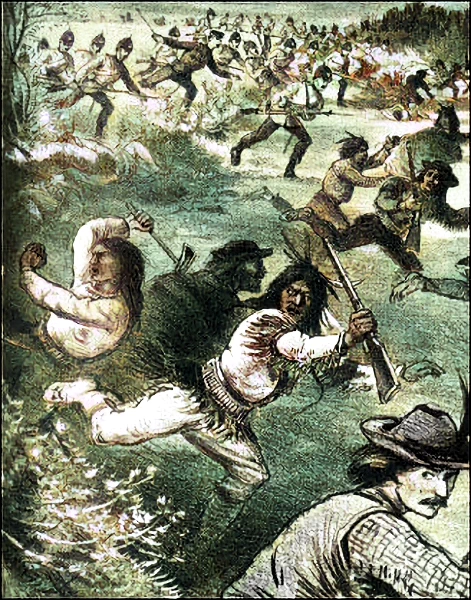
The Indians were crawling up the hill under cover of the brush but the scouts continued to advance and drove them back. One man was shot by Scout William Fielders at a distance of ten feet. The attackers' rifles got so hot at times from the rapid firing that they had to drop them and allow them to cool. Three more Indians were wounded, one of these Little Poplar finished by mistake as he was attempting to crawl back to his own people. Lone Man's horse was shot under him, the ball passing through his barrel behind the Indian's legs. Canon McKay endeavoured to parley with the enemy. A white flag was hoisted and, standing behind a tree, he demanded that they give up the prisoners. The hostiles answered with a volley from their guns. Mr. McLean sent, by a friendly Indian named Francois Mellon, a letter to the troops, but the messenger was shot through the elbow while crossing a swamp and had to return. A second attempt at parley was repelled like the first, the Indians shouting that they would annihilate the scouts. At the end of three hours Major Steele, finding himself with his small force unable to follow up his advantage, ordered a retreat and retired twelve miles to await reinforcements, carrying his wounded with him. These were Sergeant-Major William Fury of the North West Mounted Police, shot through the chest, and Scouts William West and J. Fisk of the Alberta Field Force. General Middleton came up with Steele and the augmented force of three hundred cavalry, after a delay of a day or two to make pack saddles and travois, reached the scene of Steele's fight on June 7th. The Indians by this time were miles ahead. Middleton followed their trail across the ford. At the farther side of the peninsula, he found a muskeg nearly two miles wide. It was almost impassable for the heavy horses of the cavalry, although the Indians had managed to cross with their light ponies after discarding everything not absolutely indispensable, such as sides of bacon, bags of flour and other heavy articles. The general decided it was useless to pursue the fleeing hostiles further and returned to Fort Pitt. From Loon Lake north to Lac des Isles the march 4th was terribly hard on the prisoners. The ladies were obliged to walk, often through water, with heavy bundles on their backs. Their clothing was torn, and their feet were cut and bruised through their worn-out moccasins. At the Beaver River, the prisoners pleaded to be allowed to return to Pitt, but the Indians insisted on their accompanying them still farther. Although the bands had separated after leaving Loon Lake, most of Big Bear's followers going east, the Chippewyans west and the Wood Crees north with the prisoners, the Wood Crees still feared that the prisoners might if liberated fall in with stragglers of Big Bear's band. They crossed the Beaver River on logs and in boats made of ox-hide stretched on willow withes. Stanley Simpson swam the river several times, helping the Indians across, in order to secure tea and other luxuries from them for the McLean family. At the last crossing he was exhausted and had he not been rescued by an Indian on a log would have sunk. A day north of the Beaver River the Indians decided to let them go, and they started on the return to Fort Pitt. It was a long weary march. They had been given a shotgun but no provisions. Stanley Simpson made good use of the gun and kept them from starving, walking double the distance of the others, by hunting rabbits. Even as it was they might have suffered, for thirty mouths are a good many to fill, but they were lucky enough to find an emaciated ox, abandoned as useless by the Indians. He was killed, the meat dried and, tough and tasteless though it was, it helped to keep life in the poor wanderers. At Loon Lake they were met by a party from General Middleton, who had learned of their release and sent clothing and food in wagons for their relief. Arriving at Pitt, they left soon afterward for Battleford and the East by boat. In their flight from Loon Lake, the Indians forsook a dropsical woman who could not travel fast enough to keep up with the camp. Old, ill and deserted, ignorantly fearing death at the hands of the white troops, she fixed a rope about her neck, tied it to a stump and hanged herself. |
Questions - Comments?


Links to all jkcc.com Webpages:
| Ausland Lake |
Northern Saskatchewan
| Deep River Fur Farm |
| Deep River Trapping Page |
| Deep River Fishing Page |
| My Norwegian Roots |
| Aasland Farm, Norway |
| My Norwegian Family |
| Early Mink of People Canada |
E. Rendle Bowness
| The Manager's Tale |
Hugh McKay Ross
| Sakitawak Bi-Centennial |
200 Year History.
| Lost Land of the Caribou |
Ed Theriau
| A History of Buffalo Narrows |
| Hugh (Lefty) McLeod |
Bush Pilot
| George Greening |
Bush Pilot
| Timber Trails |
A History of Big River
| Joe Anstett, Trapper |
| Bill Windrum, Bush Pilot |
| Face the North Wind |
By Art Karas
| North to Cree Lake |
By Art Karas
| Look at the Past |
A History Dore Lake
| George Abbott |
A Family History
| These Are The Prairies |
| William A. A. Jay, Trapper |
| John Hedlund, Trapper |
| Deep River Photo Gallery |
| Cyril Mahoney, Trapper |
| Saskatchewan |
A Pictorial History
| Who's Who in furs |
1952 to 1956
| A Century in the Making |
A Big River History
| Wings Beyond Road's End |
| The Northern Trapper, 1923 |
| My Various Links Page |
| Ron Clancy, Author |
| Roman Catholic Church |
A History from 1849
| Frontier Characters - Ron Clancy |
| Northern Trader - Ron Clancy |
| Various Deep River Videos |
| How the Indians Used the Birch |
| The Great Fur Land |
| The Death of Albert Johnson |
| A Mink and Fish Story |
Buffalo Narrows
| Gold and Other Stories |
Berry Richards
| Saskatchewan James Carnegie |
| Ausland Lake |
Northern Saskatchewan
| Deep River Fur Farm |
| Deep River Trapping Page |
| Deep River Fishing Page |
| My Norwegian Roots |
| Aasland Farm, Norway |
| My Norwegian Family |
| Early Mink of People Canada |
E. Rendle Bowness
| The Manager's Tale |
Hugh McKay Ross
| Sakitawak Bi-Centennial |
200 Year History.
| Lost Land of the Caribou |
Ed Theriau
| A History of Buffalo Narrows |
| Hugh (Lefty) McLeod |
Bush Pilot
| George Greening |
Bush Pilot
| Timber Trails |
A History of Big River
| Joe Anstett, Trapper |
| Bill Windrum, Bush Pilot |
| Face the North Wind |
By Art Karas
| North to Cree Lake |
By Art Karas
| Look at the Past |
A History Dore Lake
| George Abbott |
A Family History
| These Are The Prairies |
| William A. A. Jay, Trapper |
| John Hedlund, Trapper |
| Deep River Photo Gallery |
| Cyril Mahoney, Trapper |
| Saskatchewan |
A Pictorial History
| Who's Who in furs |
1952 to 1956
| A Century in the Making |
A Big River History
| Wings Beyond Road's End |
| The Northern Trapper, 1923 |
| My Various Links Page |
| Ron Clancy, Author |
| Roman Catholic Church |
A History from 1849
| Frontier Characters - Ron Clancy |
| Northern Trader - Ron Clancy |
| Various Deep River Videos |
| How the Indians Used the Birch |
| The Great Fur Land |
| The Death of Albert Johnson |
| A Mink and Fish Story |
Buffalo Narrows
| Gold and Other Stories |
Berry Richards
| Saskatchewan James Carnegie |