
|
On a bright morning in October 1884, the Plains Cree Indians of Big Bear's band were in camp on the high bank of the North Saskatchewan River above Fort Pitt. They were assembled to receive their annuities, which would be paid at for Fort Pitt on the 20th of that month. Under the treaty, the chiefs received twenty-five, councillors fifteen, and all others, men women and children five dollars each year "while grass grew and water ran." Fort Pitt was an old and important trading post of the Hudson's Bay Company, 150 miles east of Fort Edmonton and 35 miles southeast of Frog Lake. George Dill and I had made the rounds of the payments at the various reservations with a trading outfit in competition with other traders for a share of the Indians' crisp new notes. Now our tents were pitched near the Indian lodges in readiness for the business that would follow the last and largest payment, that to Big Bear and his band. The Indian's day of affluence is soon past; his money is gone almost as soon as he receives it. A new prophet and champion had arrived in the band. I had met Little Poplar a few days before. He had come from Fort Pitt to Frog Lake with an order on John Delaney, a farming instructor there, for provisions. I learned later how he had obtained it. On the trail he had met the government inspector of Indian agencies. The following dialogue ensued: Little Poplar: "Who are you?" Inspector: "I am an officer of the Great White Mother, and I come from the Pile of Bones-Regina. Each year I go around all the reserves to see how fast the Indians are learning the white man's road to make things grow on the land so that they soon will have plenty to eat. They should, of course, also get help when they are sick or in need; flour, kookoosh. I look into these things. I'm an inspector." Little Poplar: "Hai! I'm glad to hear that. I'm an inspector, too, and it is meewassin when we two inspectors meet. I've just come from the country of the Long Knives to see how my people are treated by the officers of the Great White Mother and the first thing I see is that they are hungry. Some are sick. I think you don't look very good; your eyes may not look good. Give me a musinagan to the man at Frog Lake who is teaching them to grow things a paper. Write in it that he will give me, Kah-meet-u-sis, 30 bags of flour, ten bags of bacon, tea and sugar for my hungry and ailing people. That will be good medicine!" Inspector Tomah was not accustomed to being addressed in such an arrogant fashion by the government's red wards and he was not pleased. He picked up the reins and spoke to his horses. The Indian put an arresting hand on the reins. "No, don't go yet. First, give me the musinagan, and keepah - hurry!" The objection of the inspector to being delayed prevented an immediate eruption of wrath and Little Poplar got the order. I was standing beside Farming Instructor Delaney at Frog Lake when Little Poplar drove up with his Crow brother-in-law. He was a handsome Indian. Above medium height, with clean square-cut features, full jaw, long plaited black hair, quick tongue and cool aggressive manner; his whole appearance stamped him at a glance as a savage with whom a white man, to deal successfully, must possess exceptional tact and assurance. A fancy blanket belted at the waist draped his erect, muscular figure and beneath it, he wore profusely beaded leggings and moccasins and a wide leather belt from which hung a heavy buffalo knife and a Colt revolver. On his head was a broad Stetson hat encircled by a brass band with an eagle plume stuck in the side and on his wrists brass bands and in his ears huge brass rings. He made no mention of the order, but stepping up to Delaney he said curtly: "I want 30 bags of flour, 10 bags of bacon, 10 pounds of tea and 50 pounds of sugar." Delaney looked at him curiously. "I don't know you," he said; "don't even know whether you are in treaty. We don't give provisions even to treaty Indians whenever they take a notion to ask for them. To strange Indians and those not in treaty, we give none at all." Little Poplar's lower lip stuck out; "Why doesn't the Great White Mother send us agents who are brave enough or strong enough to do things? It is men like you" - he looked insolently at Delaney - "who cause trouble between the Indians and the police like the near - fight at Poundmaker's last summer." He drew from under his blanket the inspector's order and handed it to Delaney. "Now, do I get the provisions?" he sneered. Of course, he got them. Intensely irritated though he was, Delaney nevertheless was obliged to obey instructions. The supplies were loaded into the carts that had trailed Little Poplar and he returned to Fort Pitt. T. T. Quinn, the Indian agent, followed a day or two later with the cash for the payment to Big Bear's band-and here the story is back to the point at which it began. Little Poplar has been introduced thus early to French blood, he was well educated, exceptionally intelligent, and fiad served with distinction in a Wisconsin regiment throughout the American Civil War. Afterward, he had seen many exciting adventures while employed as a scout with the regular army in frontier Indian campaigns. It was from his knowledge of the Sioux language that he had received from the Crees his name of Kapwatamut or The Sioux Speaker. He rose leisurely, turned completely round before Little Poplar and sat down again. He looked at the Indian. "Seen all you want?" he asked. The Indian scowled. "I have heard of you!" he retorted. "Away over the other side of the Missouri River, I heard of you. I started to come this way and the farther I came the more I heard. You're the man the government sent up here to say 'No!' to everything the Indians asked you" Little Poplar bent over and shot the last sentence at Quinn like a slug from a catapult. There was intense silence in the room. The agent signed to him to proceed. "Now, I am going to ask you something. I will ask it three times before I sit down. It is long since the buffalo went away. My people are hungry and would like to eat fresh meat again. Will you kill an ox before the treaty money is paid?" Quinn shook his head. "The government gives cattle to the Indians for work and milk, but not to kill. There's no beef for you." Little Poplar went on: "I crossed the Line and travelled north. After a time I came to where the grass had been torn up, and two iron lines had been laid down and stretched away east and west as far as I could see. I said to myself, 'What is this?' I thought for a moment; then I said: 'Hai, yes; I know! This is the pewabisko meskano, the iron road that the government has made to carry food and clothing in their big wagons to the poor starving Indians.' I want them to bring money out the same way in the big wagons and to throw it out on both sides of the iron road so that everybody can have plenty of it!" He turned again to Quinn. "For the second time, I ask: 'Will you give us beef?" "I've answered that question. You heard what I said," replied the agent. "Wamoya; itwayo! 'No,' he says. Akwusee keeam! Very well!" Little Poplar raised his voice. "We will have the government make a telegraph line from here to Battleford, and" - he raised the lash in his hand"I will whip the wires as they do and we will have him taken away from here! I will have a new man sent in his place before the moon grows old again. I know the government has given orders that beef is to be given us, but he won't follow them. . . . I look around me," he went on, "and of all the leaders who stayed when we went south, how many are left? I see one old man!" He placed a hand on the white head of Chief Keeheewin, then faced the agent. "For the third and last time, I ask and when you answer, speak loud so that every Indian in this house can hear you: Will you give us beef?" "No!" came the reply in the deep voice of the agent. Instantly Little Poplar faced about. "Go!" he shouted, raising his arms. "Let him keep his pikoonta money! Neeuk!" And with yells of defiance, the whole band swept out of the house, across the square and up the hill, firing their guns in the air as they went. That afternoon the Indians danced the war dance and Big Bear made a speech. He attacked the government and the Hudson's Bay Company and, ignoring the other whites present, walked up to Captain Francis J. Dickens, son of the novelist, commanding the North West Mounted Police at Fort Pitt, and held out his hand. 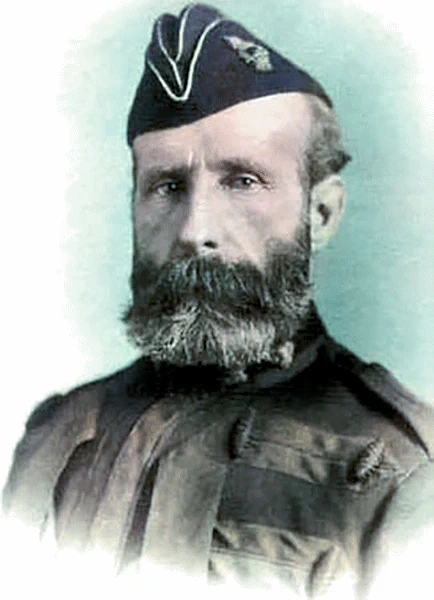
"You are a man," cried Big Bear, "whom Manitou made to be a Chief! We like you; your heart is good. As for that man" - he pointed at Quinn - "his heart is made of stone. He may go back to Frog Lake. When the governor made the treaty with us, we were told we should have a beef to eat at every payment." He placed his hands, fingers extended, on either side of his head and turned fiercely on the agent. "You want my head take it!" he cried, flinging his open hands in the agent's face as though delivering it to him. "When I am hungry this winter and ask for food," Miserable Man said to Quinn, "if you don't give it to me . . ." Quinn smiled good-humoredly. He had heard Indians talk before. He did not mind such trifles as their threats. Big Bear apologized later to everyone for his harsh words, but for two days the band danced the war dance and refused to be paid. The Mounted Police were kept constantly under arms in anticipation of trouble, and Quinn sent his half-breed interpreter to notify the chiefs that unless they came to terms he would return the following afternoon to Frog Lake. Meanwhile the Hudson's Bay Company officer, in charge at Fort Pitt, Angus McKay, having made large advances to the band, grew anxious about his debts. He ordered a steer to be slaughtered and sent as a gift to the Indian camp. This mollified the Indians; still, they objected, the beef had not come from the government. They would compromise matters, they said, by accepting the money at their camp instead of at the fort. Quinn decided to humour them and sent word that he would pay them there the next morning. 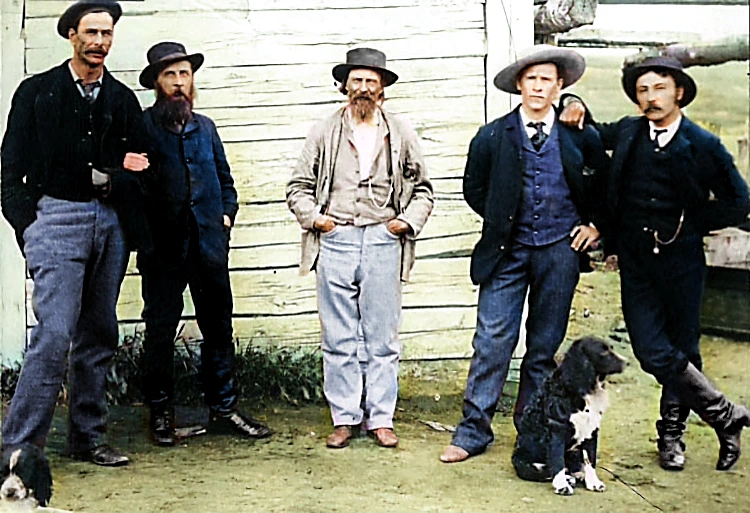
Left to right: Thomas Trueman Quinn, Indian Agent; Inspector Francis Jeffries Dickens, NWMP, son of the novelist, in command of the Fort Pitt Detachment; James Keith Simpson, son of Sir George Simpson, the great Governor of the Hudson's Bay Company; Frederick Stanley Simpson, HBC clerk, Fort Pitt; Angus McKay, Post Manager, HBC, Fort Pitt. During these days of "strained diplomacy" Dill and I had nothing to do but mind our tent store, fry our bacon, watch the Indian youngsters' deft archery and try otherwise to kill time while awaiting developments. The Indians did not molest us. They came, talked, and examined blankets, knives, prints, shawls, handkerchiefs, rings - all our stock, but without money, they could not buy. We were glad to hear a truce declared. At 8:30 the next morning two constables came with the pay tent and pitched it about a hundred yards from our quarters. They were followed in twenty minutes by Quinn, who notified Big Bear by messenger that he was ready to begin the payment. The band was in the council. After waiting for some time, Quinn walked over to our tent. "In twenty minutes it will be ten o'clock," he said, looking at his watch. "If they don't show up before then they get no money." He returned to the pay tent. A little later he passed our place carrying under his arm a box sealed with red wax. It contained the annuity money-seven thousand dollars. He had scarcely disappeared in the direction Of the fort when Big Bear, Wandering Spirit, Little Poplar and other chiefs came rapidly toward our tent. They were talking excitedly and stopped a moment to ask what had become of the agent. We told them he had got tired of waiting and had probably gone to dinner. Gesticulating angrily and with exaggerated expressions of amazement, they went on. They overtook him before he reached the fort and persuaded him to return and make the payment. For the next two days, I was busy at the store. The Indians danced and feasted and I went once or twice at night with Stanley Simpson to the dancing lodge and heard Little Poplar count his coups and tell how, using me occasionally and not altogether to my liking, as he swung his heavy Colts pistol in my direction, as representing the enemy, he had taken Blackfoot scalps. Then Dill went to Battleford, 90 miles away, to deposit our funds and bring back a fresh stock of goods, while I returned to Frog Lake and put up a log building for our winter trading quarters. Soon after Dill's return, by mutual agreement, we dissolved the partnership. He continued what had been our business and I accepted a position with the Hudson's Bay Company at Frog Lake. |
Questions - Comments?


Links to all jkcc.com Webpages:
| Ausland Lake |
Northern Saskatchewan
| Deep River Fur Farm |
| Deep River Trapping Page |
| Deep River Fishing Page |
| My Norwegian Roots |
| Aasland Farm, Norway |
| My Norwegian Family |
| Early Mink of People Canada |
E. Rendle Bowness
| The Manager's Tale |
Hugh McKay Ross
| Sakitawak Bi-Centennial |
200 Year History.
| Lost Land of the Caribou |
Ed Theriau
| A History of Buffalo Narrows |
| Hugh (Lefty) McLeod |
Bush Pilot
| George Greening |
Bush Pilot
| Timber Trails |
A History of Big River
| Joe Anstett, Trapper |
| Bill Windrum, Bush Pilot |
| Face the North Wind |
By Art Karas
| North to Cree Lake |
By Art Karas
| Look at the Past |
A History Dore Lake
| George Abbott |
A Family History
| These Are The Prairies |
| William A. A. Jay, Trapper |
| John Hedlund, Trapper |
| Deep River Photo Gallery |
| Cyril Mahoney, Trapper |
| Saskatchewan |
A Pictorial History
| Who's Who in furs |
1952 to 1956
| A Century in the Making |
A Big River History
| Wings Beyond Road's End |
| The Northern Trapper, 1923 |
| My Various Links Page |
| Ron Clancy, Author |
| Roman Catholic Church |
A History from 1849
| Frontier Characters - Ron Clancy |
| Northern Trader - Ron Clancy |
| Various Deep River Videos |
| How the Indians Used the Birch |
| The Great Fur Land |
| The Death of Albert Johnson |
| A Mink and Fish Story |
Buffalo Narrows
| Gold and Other Stories |
Berry Richards
| Saskatchewan James Carnegie |
| Ausland Lake |
Northern Saskatchewan
| Deep River Fur Farm |
| Deep River Trapping Page |
| Deep River Fishing Page |
| My Norwegian Roots |
| Aasland Farm, Norway |
| My Norwegian Family |
| Early Mink of People Canada |
E. Rendle Bowness
| The Manager's Tale |
Hugh McKay Ross
| Sakitawak Bi-Centennial |
200 Year History.
| Lost Land of the Caribou |
Ed Theriau
| A History of Buffalo Narrows |
| Hugh (Lefty) McLeod |
Bush Pilot
| George Greening |
Bush Pilot
| Timber Trails |
A History of Big River
| Joe Anstett, Trapper |
| Bill Windrum, Bush Pilot |
| Face the North Wind |
By Art Karas
| North to Cree Lake |
By Art Karas
| Look at the Past |
A History Dore Lake
| George Abbott |
A Family History
| These Are The Prairies |
| William A. A. Jay, Trapper |
| John Hedlund, Trapper |
| Deep River Photo Gallery |
| Cyril Mahoney, Trapper |
| Saskatchewan |
A Pictorial History
| Who's Who in furs |
1952 to 1956
| A Century in the Making |
A Big River History
| Wings Beyond Road's End |
| The Northern Trapper, 1923 |
| My Various Links Page |
| Ron Clancy, Author |
| Roman Catholic Church |
A History from 1849
| Frontier Characters - Ron Clancy |
| Northern Trader - Ron Clancy |
| Various Deep River Videos |
| How the Indians Used the Birch |
| The Great Fur Land |
| The Death of Albert Johnson |
| A Mink and Fish Story |
Buffalo Narrows
| Gold and Other Stories |
Berry Richards
| Saskatchewan James Carnegie |