
|
Before going any further, I wish to express to some writer or writers now to me unknown, my indebtedness for the admirable portrayal which follows of the Indian gambler, as well as for one or two passages in my description a few pages back of a camp on the march. Some thirty years ago, I was addicted to the practice of making notes in my reading of anything, which impressed me as being particularly good (as well, of course, as making notes of my own), and these descriptions are taken from these ancient notes. From my own personal experience, I can testify to their fidelity. They are good to be, omitted so good, in fact, that were I now to attempt to rewrite them, the result would be mere paraphrasing of the originals, certain to suffer in comparison. I take them therefore, as I find them, and am only sorry that I cannot thank the authors, whom I have been at some pains, though unsuccessfully, trace, by name. How much of this particular material may be mine, and how much someone else's, it is quite impossible for me now to say. The American Indian is a born gamester. Since the advent of the white man he has learned to gamble with cards, but long before he ever saw the paleface he had his own rude games of chance. In Big Bear's camp one might see gathered on any bright day in the shade of a cart an excited circle - a group of gamblers surrounded by their partisans. Let us take a look at them: 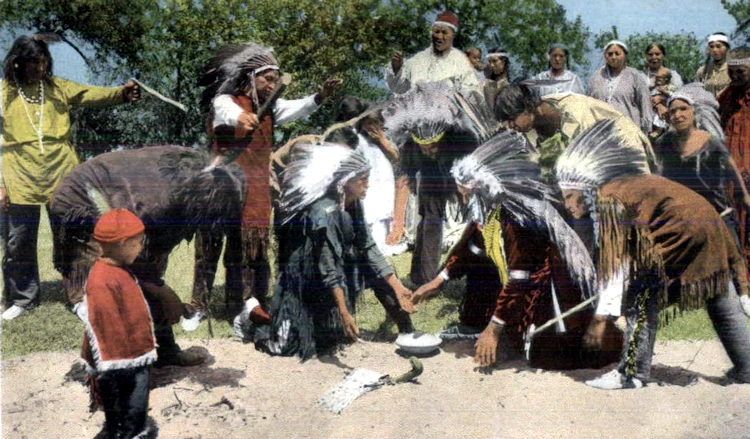
Two men are seated opposite each other on the ground with blankets over their knees. Each has beside him an assistant or partner, and a pile of articles of more or less value which he is prepared from time to time to offer as stakes. Two bits of wood an inch and a half long are the gambler's cards. The player of the side having the sticks at the time takes them in his hands, his partner picks up a small drum the size and shape of a milk pan, holding it by parchment strings stretched across its open back, and begins to sing, accompanying himself on the drum. The feet of the gambler are doubled up beneath him. He puts his hands beneath the blanket across his knees, brings them out, closed, and in time with the song jolts in his seat like a man in the saddle, bends his head, throws it back, uttering a continual sharp "Chug-chug chug-chug!" somewhat like the steam exhaust of a tugboat. Sometimes he opens a hand, displaying one of the sticks or else showing that it is empty. Again the hand dives beneath the blanket and comes out, perhaps with the stick, perhaps not. He folds his arms on his chest; he flings them out, flashing the hands open and shut. All the while the steady chugging comes from between his teeth and the body jolts up and down. If he is an expert the sticks may be passed or shot openly between the hands so dexterously that the opposing players may not see them, though they are generally exchanged under the blanket. Meanwhile his opponent sits Smoking and watching him intently. All the contortions of his vis-a-vis are intended to mislead him. His purpose is to divine correctly where the two sticks are at any given time - whenever he may choose to hazard a guess. If the guess is correct the sticks pass to the other side and a marker is stuck in the sod to represent points added to the number needed to win the stakes then being played for. If he misses the same side retains the sticks and adds a marker to its row, the stakes being put up at so many sticks or markers. The sticks may be both beneath the blanket, both in one hand or one in either hand. Again, one may be under the blanket and the other in either hand. It is a hard matter for the guesser to recover the sticks once they have passed to a clever opponent. The hands of the juggler are always opened and the sticks are at once tossed over. Occasionally the guesser receives advice and suggestions from his assistant and guesses accordingly. Signs are the language of the Indian gamester. He claps the back of one hand in the palm of the other, holding up one or two fingers according to his guess. It depends on which hand he thinks holds the sticks and which fingers he holds up, those of the left or right hand. If he thinks both sticks are beneath the blanket, he makes a different sign with both fingers down. Anything he owns may be hazarded - bedding, rifle, knife, moccasins, pipe, tobacco, saddle, horse. He may lose all, but he never murmurs. He laughs when he has nothing more to lose and goes- away singing, with a jest over his shoulder. The excitement pleases him and satisfies his passion for play. He likes to bewilder his opponent, to show his dexterity in juggling the sticks and little he cares whether he wins or loses. He will not starve, nor will he lack a smoke while there is tobacco or food in the camp. He will simply drop into the nearest lodge. 
Indians in times of war have various methods of signalling. The two in most common uses were fire and mirrors. The smoke of the signal fire, built on a commanding height, might be seen for many miles in the clear atmosphere of the prairie. At night the glow itself or its reflection in the sky were equally serviceable. By this method intelligence was carried unbelievable distances in a short time. There is little doubt that Big Bear's band was apprised through signal fires of the Duck Lake fight and the half-breed outbreak, two hundred miles away, within twenty-four hours of the engagement, while we the whites at Frog Lake did not hear of it for some days. Of course, the fires must have a relation to some event anticipated. Mirrors are available only in bright weather and for comparatively short distances, though even flashes from a small mirror may be seen in the favourable country for many miles. A given number of flashes conveys definite information of some kind. I have seen Big Bear's band thrown into a state of feverish excitement, men rushing for their guns, women talking and gesticulating, by a series of flashes telegraphed from a distance of at least five miles. A word here about the sign language in use among all the Plains Indians. It is a mistake to suppose that there is any similarity between the languages of the various stocks. The Blackfeet, Bloods and Piegans are of the same parent stock and their speech is therefore practically one. The same is true of the Crees, Chippewas and Salteaux; of the Sioux, Cheyennes and the Dakotahs, Stonies or Assiniboines; and the Chippewyans, Sarcees and Apaches. But a Blackfoot, generally, speaking his own language to a Cree, Sioux, Apache or Crow, would have as much chance of being understood as if he were addressing a Hairy Ainu in English. For example, take the simple little English word "No." In Blackfoot it is sa, in Cree namoya, in, Chippewyan eeli and in Assiniboine wanitch. The Blackfoot gets around the difficulty by "speaking signs." The fingers of both hands intertwined represent a lodge (crossed poles at the top) or a house (log). Sleep is symbolized by placing the head sidewise on the palm of the hand. Numbers are recorded by holding up fingers; opening and shutting the hands once means ten - ten times, one hundred. Closing the hand and opening it suddenly with the fingers extended signifies shooting - the flying shot pellets. Rubbing the palm of one hand on the palm of the other means to "wipe out" (annihilation). The index finger of each hand crooked on either side of the head in the shape of horns suggests the buffalo or cattle. An Indian comes into a trading post and asks for evaporated apples by touching his ear - it resembles a ring of packed fruit. Or a front tooth - beans. Each tribe has a sign. The Sioux is the cutthroat - a finger drawn under the chin. The Cree sign is two tongues; two fingers pushed straight out from the mouth. The Piegan publishes his nationality in an alien camp by rubbing his cheek with his fist - he is a painted face. The Crow moves his hands like the wings of a bird. The sign for the Snake Indian is readily suggested by a motion of the hand. The tribal sign for the Apache is not printable. And so on. There are signs for riding, smoking, baking, boiling, hearing, fighting, running, seeing, eating, drinking; for anger, drunkenness, sorrow, hunger, thirst, weariness, insanity; to the sun, moon, stars, day, night, rain, wind, heat, cold; for birth, life, death - in fact, a good sign-talker can speak far more fluently with his hands than many an educated white man on with his tongue. I have seen a Saskatchewan Cree and a Nez Perce from the Columbia seated side by side on the ground, converse for an hour, telling stories of the chase, of love and of war, without speaking a word. It was one of the most graceful, impressive and interesting conversations I have ever listened to. Also the quietest. The paints in use by the Indians also have their significance. The bright vermilion is a holiday paint and denotes cheerfulness in the wearer. The blue is used mainly by way of contrast, in forming stars and emblems upon the features. The yellow is the real war paint. A few moments before the massacre at Frog Lake, Wandering Spirit appeared with his. The eyelids and lips thickly coated with yellow ochre. It gave him a look of unspeakable hideousness, and was without doubt the signal for the commencement of the tragedy. Black is the death color, and in the evening after the massacre the lower parts of the faces of all who took part in it were painted this sombre hue. |
Questions - Comments?


Links to all jkcc.com Webpages:
| Ausland Lake |
Northern Saskatchewan
| Deep River Fur Farm |
| Deep River Trapping Page |
| Deep River Fishing Page |
| My Norwegian Roots |
| Aasland Farm, Norway |
| My Norwegian Family |
| Early Mink of People Canada |
E. Rendle Bowness
| The Manager's Tale |
Hugh McKay Ross
| Sakitawak Bi-Centennial |
200 Year History.
| Lost Land of the Caribou |
Ed Theriau
| A History of Buffalo Narrows |
| Hugh (Lefty) McLeod |
Bush Pilot
| George Greening |
Bush Pilot
| Timber Trails |
A History of Big River
| Joe Anstett, Trapper |
| Bill Windrum, Bush Pilot |
| Face the North Wind |
By Art Karas
| North to Cree Lake |
By Art Karas
| Look at the Past |
A History Dore Lake
| George Abbott |
A Family History
| These Are The Prairies |
| William A. A. Jay, Trapper |
| John Hedlund, Trapper |
| Deep River Photo Gallery |
| Cyril Mahoney, Trapper |
| Saskatchewan |
A Pictorial History
| Who's Who in furs |
1952 to 1956
| A Century in the Making |
A Big River History
| Wings Beyond Road's End |
| The Northern Trapper, 1923 |
| My Various Links Page |
| Ron Clancy, Author |
| Roman Catholic Church |
A History from 1849
| Frontier Characters - Ron Clancy |
| Northern Trader - Ron Clancy |
| Various Deep River Videos |
| How the Indians Used the Birch |
| The Great Fur Land |
| The Death of Albert Johnson |
| A Mink and Fish Story |
Buffalo Narrows
| Gold and Other Stories |
Berry Richards
| Saskatchewan James Carnegie |
| Ausland Lake |
Northern Saskatchewan
| Deep River Fur Farm |
| Deep River Trapping Page |
| Deep River Fishing Page |
| My Norwegian Roots |
| Aasland Farm, Norway |
| My Norwegian Family |
| Early Mink of People Canada |
E. Rendle Bowness
| The Manager's Tale |
Hugh McKay Ross
| Sakitawak Bi-Centennial |
200 Year History.
| Lost Land of the Caribou |
Ed Theriau
| A History of Buffalo Narrows |
| Hugh (Lefty) McLeod |
Bush Pilot
| George Greening |
Bush Pilot
| Timber Trails |
A History of Big River
| Joe Anstett, Trapper |
| Bill Windrum, Bush Pilot |
| Face the North Wind |
By Art Karas
| North to Cree Lake |
By Art Karas
| Look at the Past |
A History Dore Lake
| George Abbott |
A Family History
| These Are The Prairies |
| William A. A. Jay, Trapper |
| John Hedlund, Trapper |
| Deep River Photo Gallery |
| Cyril Mahoney, Trapper |
| Saskatchewan |
A Pictorial History
| Who's Who in furs |
1952 to 1956
| A Century in the Making |
A Big River History
| Wings Beyond Road's End |
| The Northern Trapper, 1923 |
| My Various Links Page |
| Ron Clancy, Author |
| Roman Catholic Church |
A History from 1849
| Frontier Characters - Ron Clancy |
| Northern Trader - Ron Clancy |
| Various Deep River Videos |
| How the Indians Used the Birch |
| The Great Fur Land |
| The Death of Albert Johnson |
| A Mink and Fish Story |
Buffalo Narrows
| Gold and Other Stories |
Berry Richards
| Saskatchewan James Carnegie |