|
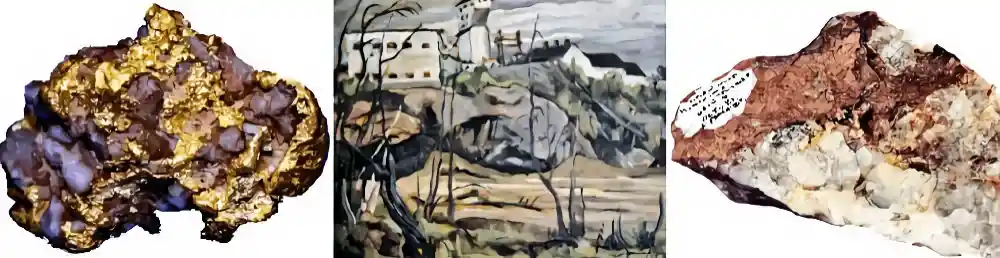
Many people have a misconception as to what exactly is a "staking rush". They have this picture of men in fierce conflict, even inflicting physical injury on each other in the mad race to get there first and stake the "Mother Lode". But in real life, at least here in Saskatchewan, it wasn't quite like that, there was a race, yes, to the favourite spots, but physical violence played no part. 
Al Scarfe was the Mining Recorder in the Uranium City area when uranium first became "hot" and says . . . . Two prospectors after the same ground, it happened regularly. One of the unfortunate things at that time, was that mineral claims used to come open for restaking on a given date. But they'd come open at midnight, rather than early in the morning, as they do now. Now they come open at seven o'clock in the morning on the first of the month. But at that time they'd come open at midnight on any old day of the month. I remember particularly there was one group of claims coming open down at Goldfields, there must have been thirty people out to stake eight or ten claims at midnight in midwinter. I particularly remember Sandy Loutitt who was going along. The topography was very high and very rocky, and Sandy was going along with a Coleman lamp, in the middle of the night, and he stepped over a cliff. So when he arrived at the office to record his claims he was sort of battered and bruised, I don't remember whether he got the ground he wanted or not. But it was ridiculous - these people out working very hard, running lines parallel to each other and trying to mark their posts a few minutes earlier than the next guy and changing information, everybody rushing into town, very secretive, It was just unreal. Arguments became pretty loud in the office at times, but we never had a fistfight. I didn't frequent the beer parlour and was not told of any violence there, but I expect there was some. Some enmities then lasted for years; so and so just wouldn't trust so and so. But most people were pretty reasonable, once their emotions came down, they were pretty good. When I went to Uranium City in 1954 we had, in effect, a constant staking rush up to midsummer of 1955, when the federal government announced that they didn't want any more uranium, at which time everything went into a tailspin. But up to that time there was plenty of activity, with people coming in from all directions. We were so busy in the office, we had a full-time draftsman to do nothing else but keep our maps up to date. He was there for a year and a half. There were hundreds and hundreds of claims being staked. The facilities we had, by present standards, were very crude. We had a map printer that took up to five minutes to do just the printing stage of a claim map. We had a very crude developer bath that used two big tubes of ammonia. In the winter of 1954, we had these two big tubes sitting in front of the hot air register, going full blast. Everybody in the office was crying from the ammonia fumes. People would come with despite forty-below weather, and as soon as they had done the necessary work they'd rush outside and freeze. It was wicked, but at least it got rid of them - Al Scarfe. At that time they were all claims, not the large blocks that can be staked now, each application for each claim had to be sworn in. Everyone had to file an affidavit for each claim, so we operated a Bible that sat on the shelf and we ran it very strictly. Everyone kissed the Bible, whether he liked it or not. If he didn't kiss the Bible, he didn't get his application accepted. There was some pretty rough language before that Bible, but it was either that or nothing! In 1957, there was a rush for claims when the Government issued the results of aeromagnetic and electromagnetic surveys of an area north of La Ronge. Claude Morrison was the Prince Albert Mining Recorder when this rush took place . . . . The Government put out the survey maps on July 12, 1957. They were released to the public at the same time from all our offices, including Regina. We had just opened our office in La Ronge and I was in the office here in Prince Albert. We had the maps all locked up in the vault. Ray Williams, our Mineral Claims Inspector, started with them at three o'clock in the morning, so he would get to La Ronge for opening at seven. They had been lining up at the La Ronge office since three o'clock that morning. Bill Knox was sitting right beside the door at two o'clock. When the doors were opened at seven, we sold the maps as fast as we could. The prospectors had radio communications in the field, and men in town to interpret the maps and radioed out in code to the men in the field to stake certain areas. As a result of these maps, we recorded about 30,000 claims, over a short time, about a month and a half, at five dollars a claim. 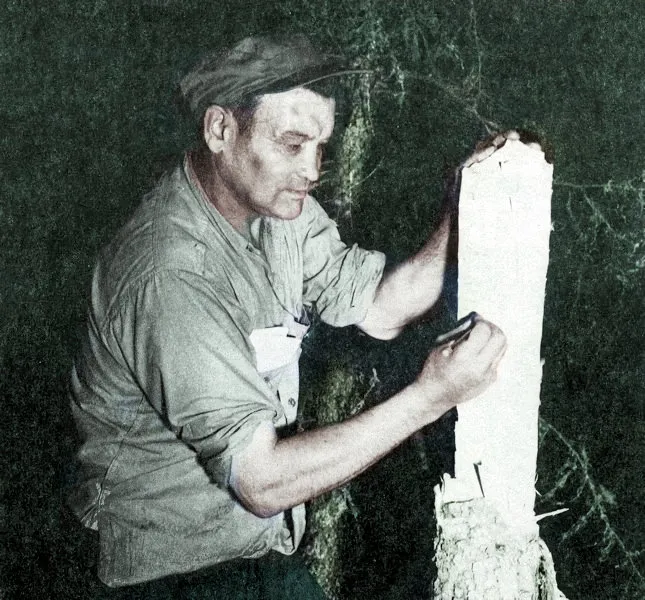
The release of new survey maps covering a 1,700 square-mile area near La Ronge resulted in a rush to stake claims in northern Saskatchewan. Here Jim Brady, a staker for Pre-Cam Exploration and Development Ltd., finishes marking the first claim post less than an hour after maps had been picked up, by geologist Berry Richards at the Department of Mineral Resources Recording Office, La Ronge - a point 75 miles away, July 1957. One bunch of applications came in all in French. Also, they were staked on the wrong declination of the compass, so I had to refuse them. They were staked by a group of professional stakers from Quebec. So we held the ground for them, and they straightened out their lines the next winter. You see, the magnetic north is not in the same direction in Quebec as it is in Saskatchewan. The claims had to be staked true north and south, within five minutes. Luckily I had a lady working with me, Helga Moltke, who could read and speak French fluently, so she translated the applications for me. There weren't any complications, for that amount of claims in that short time, everything went pretty well, and we never had one dispute. We had a few arguments, but when it was all sorted out everyone was happy. 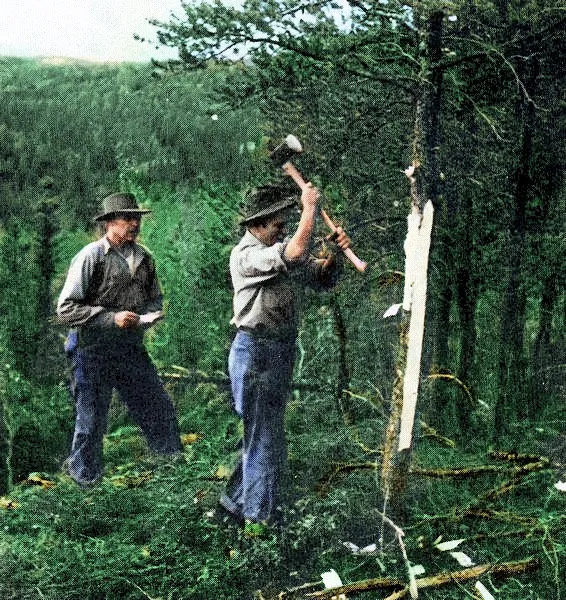
Some of the large operators had their own aircraft leased for exploration. So when the 1957 staking rush occurred out of La Ronge, they were at an advantage over the individuals who had to scramble for aircraft. George Horne was flying for one of these large operators. During the staking rush of 1957, I was flying Canadian Nickel personnel. Quite exciting for me, but more exciting for the geologists who were planning the staking. They had the crews all ready, and as soon as they got the maps, out we'd go. John Mullock was the Resident Geologist who indicated where to stake. As soon as we returned from putting out one crew they had more crews and more places to go after the first day pretty near everyone had the ground he wanted. Sometimes there would be two planes landing on the same lake, both dropping staking crews, I never heard the results. The ones who got the ground were those who were best organized, who did the best and fastest staking, and got back and recorded it. Fairchild FC-2W1 - Having improved the aerial camera and found it too sophisticated for existing aircraft, Sherman M. Fairchild, an American, built his own, the FC-1, forerunner of the FC-2W1. 
Although no FC-2W1s were built in Canada, the almost identical FC-2W2 and Model 71 were, and several FC-2W 1 s gained fame here. Piloted by Romeo Vachon, G-CAIP flew the first airmail run to Seven Islands and dropped the mail by parachute. In 1928, another FC-2W1, piloted by "Duke" Schiller, helped rescue some German flyers stranded on the Strait of Belle Isle. Source: Commemorative Stamp Bulletin, Canada Post, Philatelic Service, Issue Date 1982-10-05. Stamp designed by Robert Bradford and Jacques Charette of Ottawa. 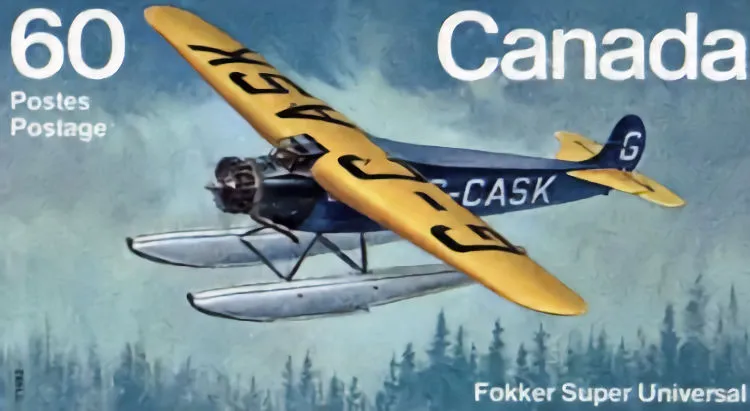
This aircraft evolved from the Fokker Universal designed by Robert Noorduyn. Canadian Vickers Limited of Montreal built about fifteen Super Universals. In 1928, "Punch" Dickins piloted G-CASK (perhaps the most famous of Canadian bush planes), an American-built Super Universal, 3,965 miles in a celebrated aerial exploration of the Barren Grounds. In 1929, another arctic expedition was forced to abandon G-CASK. When recovered eleven months later, it started with little trouble. Another Super Universal that sank in the Burnside River flew perfectly when salvaged. Source: Commemorative Stamp Bulletin. 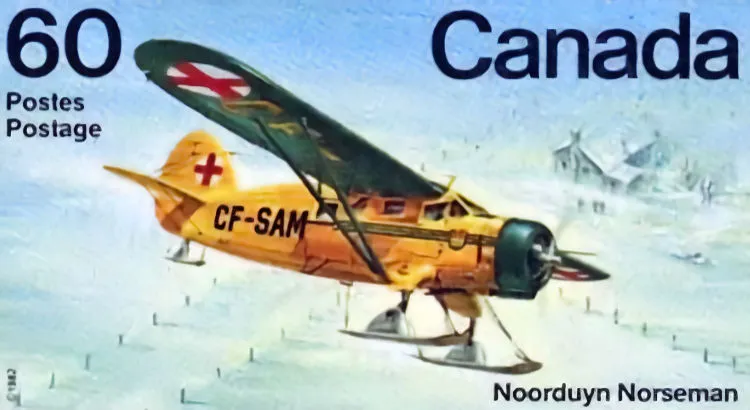
In 1934, Robert Noorduyn an expatriate Dutchman, arrived in Montreal, where he produced a rugged, high-wing, single-engined monoplane with the ability to take off and land in a short distance with a good load. The plane first flew in 1935, sales were slow until the second world war. The RCAF used the Norseman for wireless and navigational training and later for search and rescue. The Saskatchewan Government Air Ambulance Service owned the aircraft depicted on the stamp. Source: Commemorative Stamp Bulletin. Norseman CF-SAM subsequently served Saskatchewan Government Airways (later Saskair, then Norcanair) in northern Saskatchewan, transporting many prospectors and geologists to their field camps. It has subsequently been restored to its Air Ambulance colours and hangs in the Western Development Museum at Moose Jaw - R. L. Cheesman. 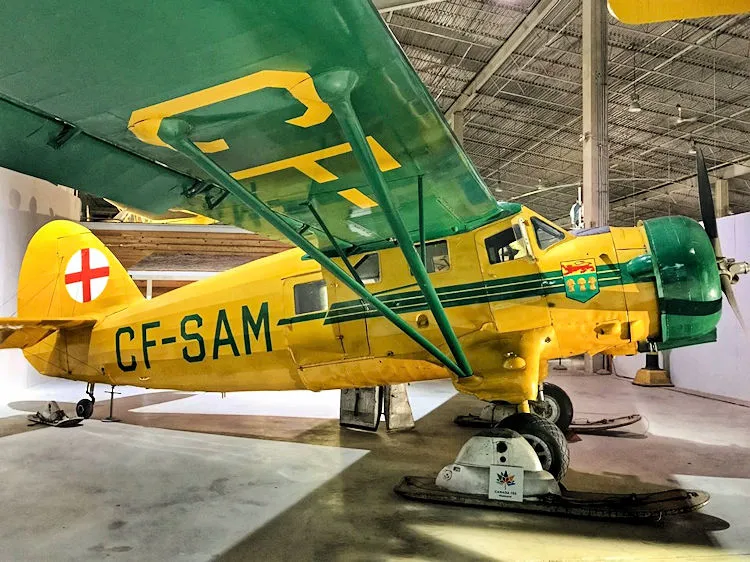

Shortly after the Second World War, the Ontario Provincial Air Service sought an aircraft to replace its ageing fleet. de Havilland Canada examined the needs of the OPAS and other bush operators and designed the Beaver. The prototype, shown on the stamp, first flew in August 1947. From then to 1968, de Havilland built almost 1,700, selling them in Canada and more than sixty other countries. So sturdy and reliable is the aircraft that a used Beaver sells for more than its original price. Source: Commemorative Stamp Bulletin. Beaver CF-FHB, Serial #1, ended its working days in northern Saskatchewan with Saskair, later Norcanair. In 1982, it was flown to Ottawa to a permanent resting place in the Aeronautical Museum at Rockcliffe - R. L. Cheesman. 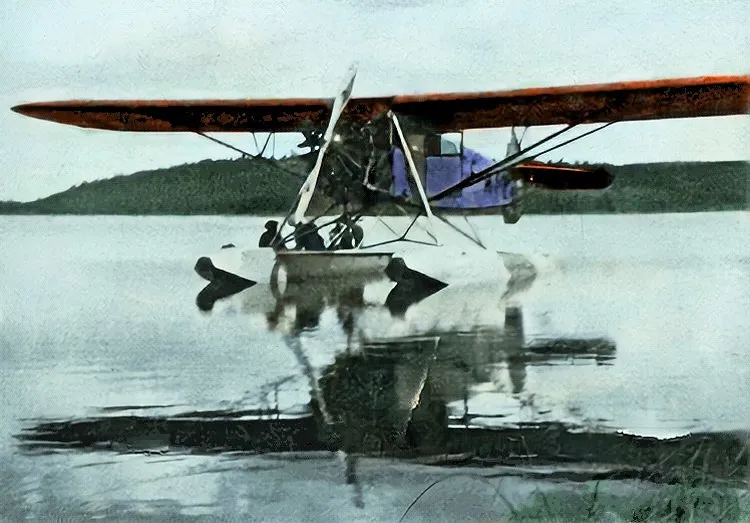


Ten years later, in 1967, there was a bit of a flurry in the La Ronge area, after Scurry Rainbow Oil Company publicized a copper-nickel find in the Otter Lake district. By this time Al Scarfe was the Mining Recorder at La Ronge. In 1967, Scurry Rainbow found a very interesting nickel property near Otter Lake. They did a lot of promoting on it and it looked pretty good for a while. There was a great deal of staking going on for a few months, but it was a different ball game because at that time we had adopted the claim block, which made staking much simpler as you were permitted to take out much larger pieces of ground at one time. Our office facilities at La Ronge were excellent, we were prepared, we had the equipment, and we had the personnel, but still, it was a lot of work. We had a few foul-ups you might call them, but they didn't compare with the conditions we faced in the mid-fifties. As well as full-scale rushes, there were "mini-rushes", involving a small area and only a few contestants, such a one occurred over the Eureka claims in the McKay Lake area, about forty miles northeast of La Ronge, and is reputed to be a good gold show. Vicki Nemanishen, one of Saskatchewan's very few women prospectors, was in the middle of this one . . . . The Eureka claims, the ones we staked in 1962, were coming open, there were two or three parties after those claims. At that time, we had to have a license yet for staking and I came to purchase my staking license and in the office, they informed me there were two or three parties after those claims. I said they have just as much chance as I have and I have just as much as they have, and I said, "I'm going". There was a fraction of a claim between my claims and the Eureka claims, it was a strip, about 200 feet wide at one end and 300 feet at the other. I asked Vern Studer if he would stake it for me, and he said okay. I paid him right there in the office for the staking and he staked it. The next day Pete Friesen went to stake the fraction, he came back to Vern Studer and said, "You staked that fraction for Victoria Nemenishen?" Vern said "Yes". Pete Friesen had organized his party along with John Albrecht to stake the claims, and Ted Kennedy, the geologist for Contact Gold Mines, was in the office when I was buying my license. Claude Morrison pointed him out to me, it was all very exciting. We got out there on the thirtieth and on the first the claims were open for staking, we slept in the tent. Before going we stopped at Vern Studer's, John Albrecht was there and he said that Pete Friesen had asked him to stake claims. "But I told him that if a woman is going to stake claims, I'm not going". We got up in the morning at about six and I was at my position at seven o'clock sharp and put my post down. We staked the claims. I came back to the camp and made dinner. When the men came in my son said that Pete Friesen was staking behind us, he told my son there was a "minor technicality" involved. It concerned the interpretation of the regulations as to the time of the posts, he was claiming my claims were no good because I had staked them at exactly seven o'clock. They had a court hearing about it in Regina, he took us to court, we didn't have to go, and we won the case, we still have those claims. 
The most exciting of all was the diamond - yes, diamond rush, in the jack pines north of Prince Albert. We have two accounts of this one, the first from Helga Reydon, then Helga Moltke, secretary and receptionist at the Prince Albert office . . . . I never was out of the office until we had that diamond rush here, that was the most wonderful thing. It all started from one of the courses Malcolm Norris had at the Penitentiary, one of the inmates finally got out and started to use his knowledge. That would be about 1963 or so, this man - this was all a deep dark secret, cloak and daggers sort of business - this man had gone to Winnipeg; which was his home, and got in touch with people there, a family that had some money. Then he returned here with this idea about these diamonds for commercial use, and that they were often found in gravel deposits. He was convinced there was a diamond mine across the river, this was never confirmed, but the De Beers people from South Africa were interested. Naturally, this couldn't be completely secret, so in no time at all practically all of Prince Albert was staking diamond claims. It was then I got out of the office, they were so busy I had to go out to help check to see if the claims were in the right place, and all that. All the people engaged in mining were involved - the Studers, the Parreses and people like that. It ended up, of course - nothing - no diamonds. 
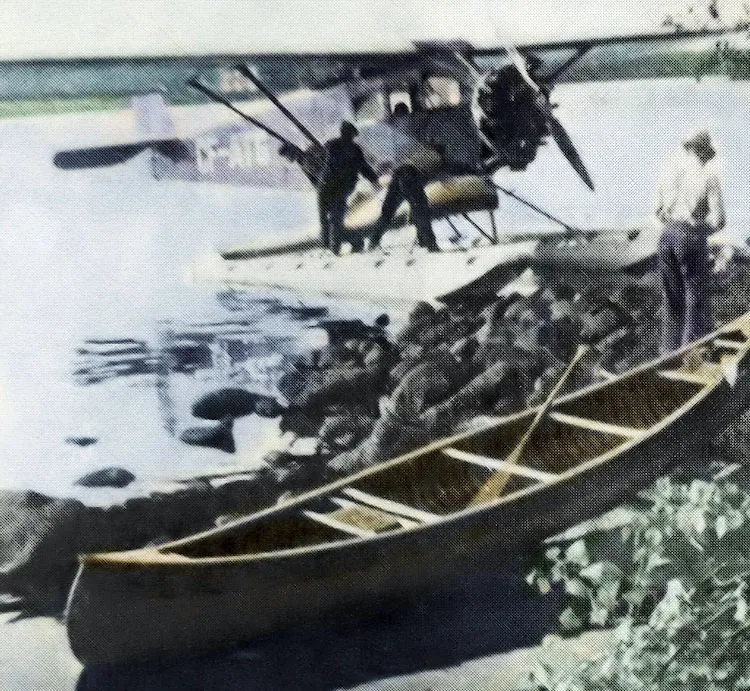
This airplane was Saskatchewan's first air ambulance but was later attached to the Fire Control's smoke jumping unit. When this photograph was taken the plane was on a forest fire control trip for F. Warburton, Director of the Fire Control Branch, Department of Natural Resources, who is in the centre of the picture with his back to the camera in the group of three men. Bob Gooding, Director of the DNR Construction Branch, is in the foreground with his back to the camera and next to an unidentified man in a dark jacket believed to be, an engineer for the federal Department of Public Works. He and the man in shorts, were then locating a suitable place for a large dock to be built. Bob Gooding and Ray Hovdebo, a civil engineer with the DNR Construction Branch, were visiting the crew building the road from Bushell to Eldorado. The pilot was Charlie Thompson who here received word from his union to return the aircraft to La Ronge, as the employees of Saskatchewan Government Airways had gone on strike. To the extreme right is Earl Dodds, then Field Supervisor responsible for northern forest fire control operations. 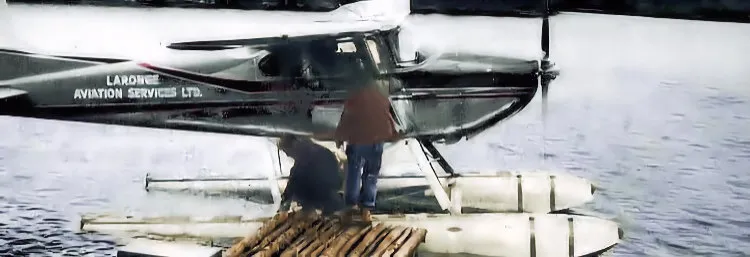

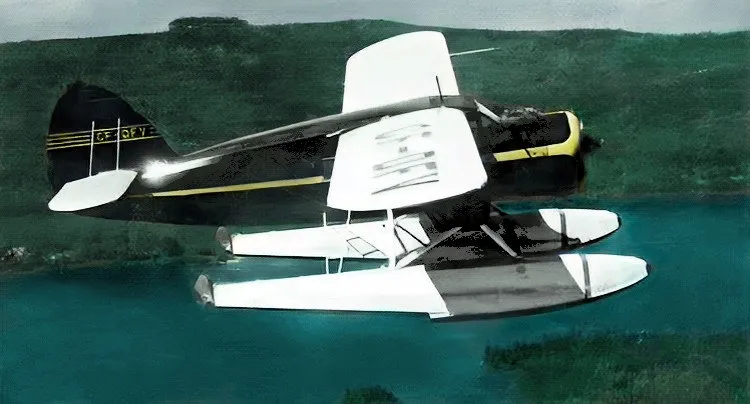
This aircraft, the last survivor of less than a dozen built in 1936, was in service in Transair's colours as late as the early sixties, servicing field parties and fish camps from Lynn Lake, Manitoba. It is believed to still survive somewhere in northern Ontario. R. L. Cheesman. 
At the time of the "Diamond" rush, Claude Morrison was Mining Recorder at Prince Albert and says . . . . This man was discharged from the Penitentiary. He went out and staked. He came to my office with some applications and he had them properly staked, just north of town 6 or 7 miles. He claimed there was a diamond mine out there and it really started a rush, too. I think there were 500 claims staked there in no time, it was just gravel, that's all there was and pines. A lot of people in town were out staking, the Parres boys were out there - Lew and Jim. They came from all over Canada staking claims for diamonds, but there were no diamonds, this man sold his claims, too. Finally, people started to catch on, and we brought in some geologists who said there was nothing there. A lot of people insisted there was, and hung on to their claims, and they paid their $100.00 a year too, some prospectors sure are optimistic, I'll tell you that. 
|
Questions - Comments?


Links to all jkcc.com Webpages:
| Ausland Lake |
Northern Saskatchewan
| Deep River Fur Farm |
| Deep River Trapping Page |
| Deep River Fishing Page |
| My Norwegian Roots |
| Aasland Farm, Norway |
| My Norwegian Family |
| Early Mink of People Canada |
E. Rendle Bowness
| The Manager's Tale |
Hugh McKay Ross
| Sakitawak Bi-Centennial |
200 Year History.
| Lost Land of the Caribou |
Ed Theriau
| A History of Buffalo Narrows |
| Hugh (Lefty) McLeod |
Bush Pilot
| George Greening |
Bush Pilot
| Timber Trails |
A History of Big River
| Joe Anstett, Trapper |
| Bill Windrum, Bush Pilot |
| Face the North Wind |
By Art Karas
| North to Cree Lake |
By Art Karas
| Look at the Past |
A History Dore Lake
| George Abbott |
A Family History
| These Are The Prairies |
| William A. A. Jay, Trapper |
| John Hedlund, Trapper |
| Deep River Photo Gallery |
| Cyril Mahoney, Trapper |
| Saskatchewan |
A Pictorial History
| Who's Who in furs |
1952 to 1956
| A Century in the Making |
A Big River History
| Wings Beyond Road's End |
| The Northern Trapper, 1923 |
| My Various Links Page |
| Ron Clancy, Author |
| Roman Catholic Church |
A History from 1849
| Frontier Characters - Ron Clancy |
| Northern Trader - Ron Clancy |
| Various Deep River Videos |
| How the Indians Used the Birch |
| The Great Fur Land |
| The Death of Albert Johnson |
| A Mink and Fish Story |
Buffalo Narrows
| Gold and Other Stories |
Berry Richards
| Saskatchewan James Carnegie |
| Ausland Lake |
Northern Saskatchewan
| Deep River Fur Farm |
| Deep River Trapping Page |
| Deep River Fishing Page |
| My Norwegian Roots |
| Aasland Farm, Norway |
| My Norwegian Family |
| Early Mink of People Canada |
E. Rendle Bowness
| The Manager's Tale |
Hugh McKay Ross
| Sakitawak Bi-Centennial |
200 Year History.
| Lost Land of the Caribou |
Ed Theriau
| A History of Buffalo Narrows |
| Hugh (Lefty) McLeod |
Bush Pilot
| George Greening |
Bush Pilot
| Timber Trails |
A History of Big River
| Joe Anstett, Trapper |
| Bill Windrum, Bush Pilot |
| Face the North Wind |
By Art Karas
| North to Cree Lake |
By Art Karas
| Look at the Past |
A History Dore Lake
| George Abbott |
A Family History
| These Are The Prairies |
| William A. A. Jay, Trapper |
| John Hedlund, Trapper |
| Deep River Photo Gallery |
| Cyril Mahoney, Trapper |
| Saskatchewan |
A Pictorial History
| Who's Who in furs |
1952 to 1956
| A Century in the Making |
A Big River History
| Wings Beyond Road's End |
| The Northern Trapper, 1923 |
| My Various Links Page |
| Ron Clancy, Author |
| Roman Catholic Church |
A History from 1849
| Frontier Characters - Ron Clancy |
| Northern Trader - Ron Clancy |
| Various Deep River Videos |
| How the Indians Used the Birch |
| The Great Fur Land |
| The Death of Albert Johnson |
| A Mink and Fish Story |
Buffalo Narrows
| Gold and Other Stories |
Berry Richards
| Saskatchewan James Carnegie |