|
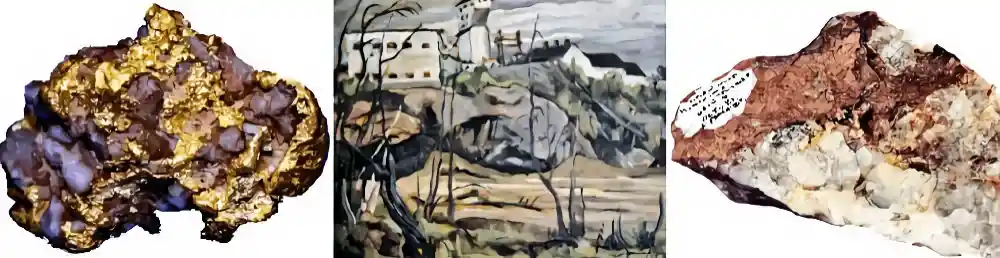
The Amisk [Beaver] Lake area attracted prospectors and mining people in the very early days after the Flin Flon orebody was discovered in 1915. But gold was the first target, as Arnold Agnew reported when he talked about the Beaver Lake Gold Mines Company, which was organized in Prince Albert. Attention later became directed at the base metal potential of the area on account of discoveries made by local prospectors and the geological work done by Dr Byers. Dr Walter Kupsch, a colleague of Byers at the University of Saskatchewan, underlines the importance of this work. I think what Byers did in that area was one of the finest mapping jobs we have anywhere in Canada, in the Precambrian Shield. Rod Byers was a very thorough man, and for the first time that work was done in such detail and I think it paid off. 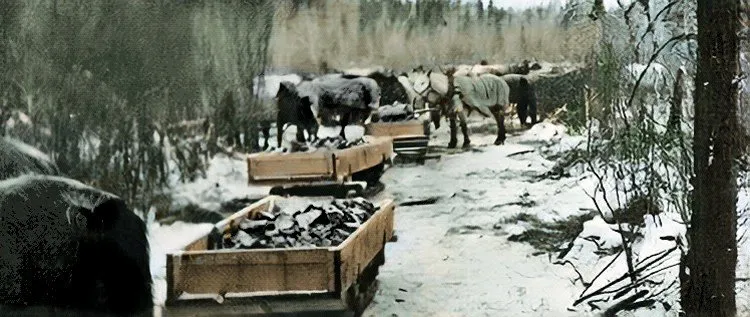
The first major base metal discovery in the Amisk Lake area was made by Joe Brain, millionaire (now) prospector of Flin Flon, Manitoba, no one can tell it like Joe. Birch Lake happened in 1949, in the springtime coming back from Table Lake, that's about 5 miles south from Birch Lake. I was looking, it was a nice time to see the rocks, snow was down and no mosquitoes. Nice and fresh all around and I had my dog with me. Nice company. When I came into Birch Lake there was still ice, I passed a hundred times with canoe and walking on the shore around that small island and never stopped. Something tell me, "Joe, how come you don't look at the island?" My mistake, but I went and climbed the shore. I break the rock it was a shear zone, and I notice a little bit of green stain - copper stain. I didn't pay any attention, I'd seen it many times. But I break another rock, I worked a couple of hours and then went home. The next day I say, "Wait a minute. I've been going far away, and not looking at things close to home, that a shame, a crime for me." Then I got my grubhoe, shovel, pick, packsack and I went there and I worked all bloody day, there was nothing. But I kept breaking rocks and I said I'm going to find something. Nothing, all day went for nothing, I was tired, coming home, make the supper, and I figure that's enough. I have to spend time some place else. Next morning I change my mind, I'm running there again, I start digging there and I notice there was some rust and sulphides. I break, I wasn't sure if it was copper or pyrite. I dig about three feet down and come into some solid rock. I break and I see solid sulphides. But what? Pyrite, pyrrhotite, or chalcopyrite? When you look, working in the sun, changing colour fools you. Then I come home, I take the samples and make supper. Next day I should take some more samples and assay, But I was rushing because the ice was not solid. In a short time the ice would leave. I rushed that morning, I spent half a day, took some samples and put in the shed next day, I dried the samples. Bill Neelands, he was geologist for the Saskatchewan Government. I told him I wanted to assay if there's any good values. He told me, "Can I see them?" He looking and he said, "Joe, that is the chalcopyrite, it's a good one." I went to see Joe Hasking, he was Chief Geologist at Hudson Bay Mining and they assayed, and they called me about two days to the office, and they said, "Can we go and see your showing?" I said, "I haven't got a showing yet, just in a pit you know. I don't know how wide, just a few inches". He told me it doesn't matter. It's a good grade. It was 4.25 per cent copper and he wanted to see it. He told me he likes to see it and I told him you can't. Why? The lake is breaking. You have to wait for a few days. So then I stake nine claims. In Saskatchewan then one man allowed only nine claims. I was a prospector, one man. A corporation could stake 900 claims, they have so many men. I staked the south end of the lake, both sides. Okay. Pass about ten days, they call me again. Albert Koffman, exploration head, came back and says, "Joe, can we go there?" And I tell him, "Yes." Ed Hunt, an engineer, and Albert Koffman, we go there. They took what you call a lunch, enough for 20 people. He took a camera. And we paddle in my canoe to that island. I show Albert the showing, and he said "It's too small." I told him, "Albert, those small sometimes growing." I talked with Hunt and Albert went all around the island, looking here and there. He spent about, I don't know, forty minutes. He came back and I ask him, "What have you been doing? You haven't got a hammer to break the rocks." "No", he told me, "I just wandering." "What did you find there?" "Nothing." "You must. The island is small. You must have found something." "Well", he said, "Joe, we're going to option. We going to stake some more claims. Working option. We not going to give any money." They said not supposed to be any copper west of Flin Flon. I was with people who know more than I was supposed to. So I'm saying they are dumb or I am dumb. Well, I said give them a chance. I had $75,000 coming if they find something. Not one penny in the first payment, or the second payment. I make the deal about August, September. Dr. Byers, saw me the next year, "There's nothing there. It's just a pimple." I told him those pimples sometimes grow and turn into a big pimple. They started drilling in 1949, December 15. They make one hole south of the showing, about 350 feet. They hit disseminated pyrite, no copper. They drill one hole about 200 feet north. They hit Pyrite. They told me, "Nothing Joe. We're going to drill one under showing. They drill one under showing. They drill 350 feet north. They finish. I thought, "Oops, they moving out". I saw John Macdougall. He was a geologist looking after drilling. I said, "John, are you moving out?" "No, we're moving west. We're going to drill another hole". I said, "Why?" He said, "Joe, we got 16 inches of 15 per cent copper. You know at the surface there was six inches." They drilled 750 feet from west to east and they have about three feet of the same grade. They drill another hole, about eight or nine hundred feet. They finished. Albert went there. He stops at my cabin and says, "Joe, come on home". I said, "No, I had lotsa work". Then he said, "Joe, I going to tell you something". I knew he had something. "Last night we pulled a hole. We had five and a half feet of good ore". He told if we have ten feet like that we have a mine. The next day on my way to Table Lake I stop there. There were two drills. It was really good. They had intersections unbelievable, not wide, but the grade! Macdougall told me, "I guess we have a mine". Joe Brain, I first met him in 1932. He was kinda prospecting and he was cutting wood. He used to come in to me and ask me if I could sell it for him. I used to sell it. I gave him money. Lotsa times he didn't have a nickel to his name and I helped him. And then when he staked claims at Birch Lake I gave him money to register them. I'm not sure, but I got a share in it. A few years after that I sold it. People wanted to buy it. I got a little money out of it. Since then Joe doesn't talk to me! Just because I got a little money out of it. - Sam Hankin, Flin Flon merchant. And that's the story of the discovery and drilling of the Birch Lake Mine. The ore averaged 7.95 per cent copper, about four times the grade of an average copper mine. Joe got $75,000 for it. Joe never got over that. But he agrees he made up for it on the next deal with Hudson Bay Mining and Smelting, when he dealt them the Flexar property, just north of Birch Lake. Joe gloats a little when he tells it. When the deal came in for the North Property, which I had, the Flexar Mine, which was staked in 1941 as a gold property, I had three claims. After they find the Birch Lake Mine I stake more ground. I had 21 claims altogether. If I'd known 25 per cent then of what I know today, I would of a had the Coronation Mine, I had let it go. They told me there was no copper mine west of Flin Flon. They must know, so I let it go, they had the instruments, they should know. But the Flexar Mine, we did a little better. We got $75 a claim, cash, and 20 per cent interest in the company. A lot of people benefitted from Flexar. I had quite a few friends, good people. I told them to stake a few claims, and I helped them. They paid me nothing, after that, the people were crying that I had more than they had. 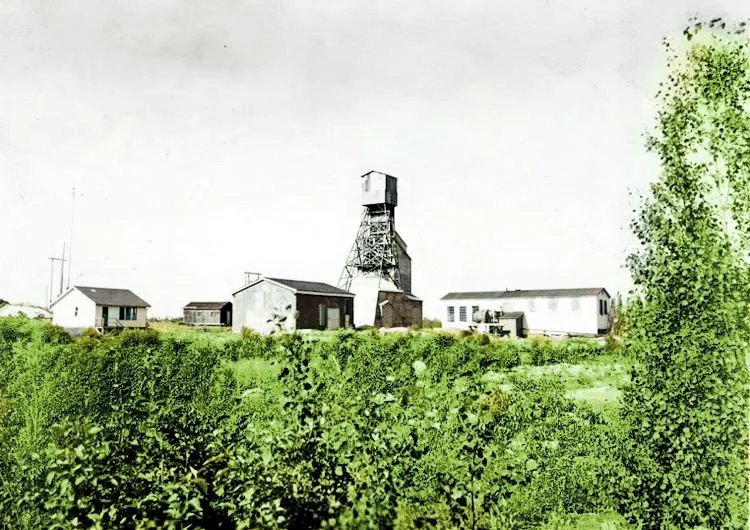
They mined about 350,000 tons of ore about 5 per cent copper. The mine paid $5.35 dividends a share and we had 200,000 shares. They mined for three years until the free tax period was over. They can move to a new mine with men, money and equipment and start making money again. Joe Brain had some cheque stubs of money he had received from Hudson Bay Mining and Smelting Company for the Flexar Mine. One dated April 29, 1970, was for $52,172.55, being his dividend for one month. Dividend number two was $40,228.55 and so on. The beauty of prospecting I guess, is the freedom of being out in the wilderness. A feeling of nature; the campfire, and that sort of thing, even if you didn't make a nickel that summer, no discoveries or anything. It takes time. You have to age a little, and mellow - George Findlay. 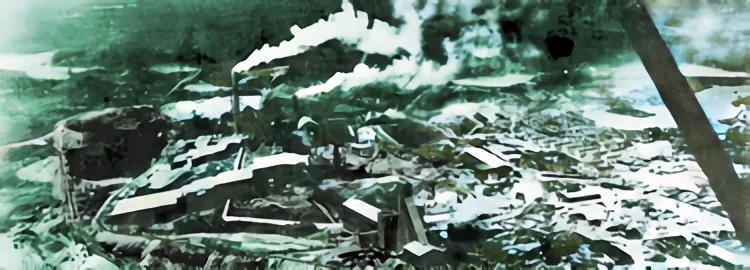
PROSPECTING AND THE MINES. "In 1915, the Mandy deposit was discovered - so they sank a shaft. It was one of the highest grades of copper and zinc, it ran at $22 a ton. 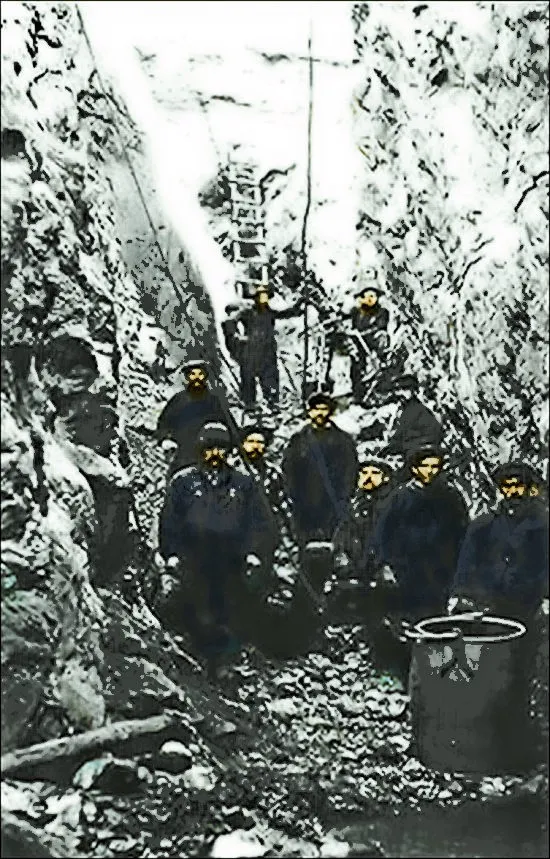
Mandy Open Pit mine, Circa 1917.
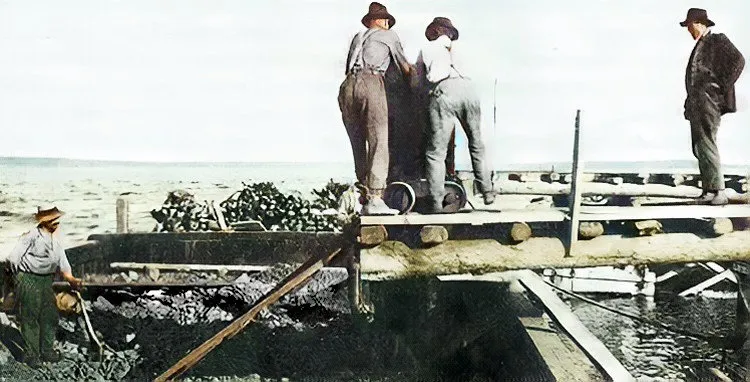
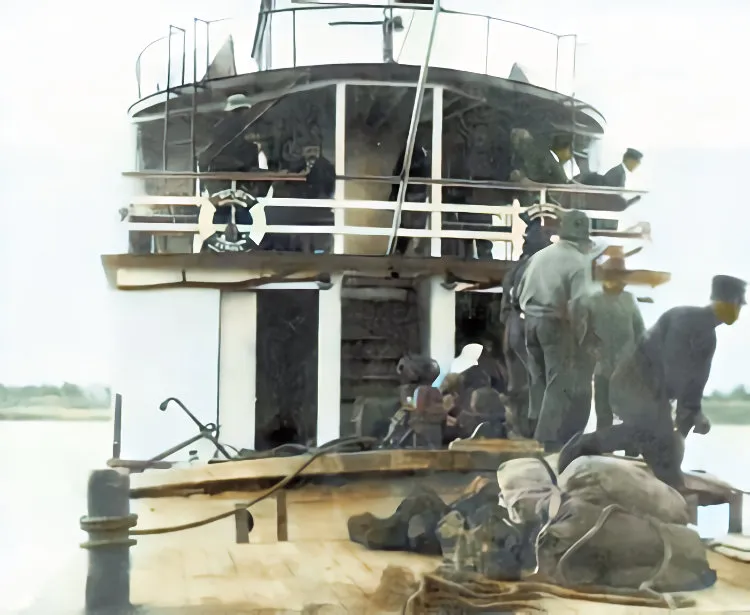
In those days there weren't any railroads. It was about 100 miles from Flin Flon to The Pas, Manitoba - the closest railroad. They then shipped the ore to Montreal. When they started to haul the ore, a man by the name of Charlie Morgan took the contract. He was using 90 teams of mules. He hauled the ore as far as Sturgeon Landing on Namew Lake. They stockpiled it there; that was a winter operation. From Sturgeon Landing to Flin Flon, it was 45 miles. The bush road was very good during the summer but the mules couldn't take it so they decided to use barges. They had a riverboat sternwheeler named the City of Prince Albert. The riverboat and barges hauled as far as Cumberland House on the Bigstone River to the Saskatchewan River just above Cumberland Rapids. From there, the riverboats would drop the barges and they would shoot the rapids. There were three tugs from below Cumberland House to The Pas: Newton, the Brisbane and the Menowsin. They each hauled one 300-ton barge. The sternwheeler would winch the empty barges up the rapids and push them back to Sturgeon Landing for another trip. This operation lasted all summer long. It started from about 1915 to 1920 during the war. They had to make copper bullets. There was a government dredge operating at Cumberland Lake to keep the silt from flowing into the Bigstone River, and to keep the riverboat City of Prince Albert operating as the channel was too low." - as told by John Dorion "You take the mine at Flin Flon. That was old David Collins' trapline and the Sherritt Gordon mine was Charlie Challett's But these men were native people; they are not recognized today and they were the founders of these mines. These were the men who brought the minerals to the white man, but they didn't know how to stake the claims and they didn't know who to deal with." - as told by Pierre Carriere (Source: Bicentennial Committee of Cumberland House, 1974, p.11-12)CUMBERLAND HOUSE. 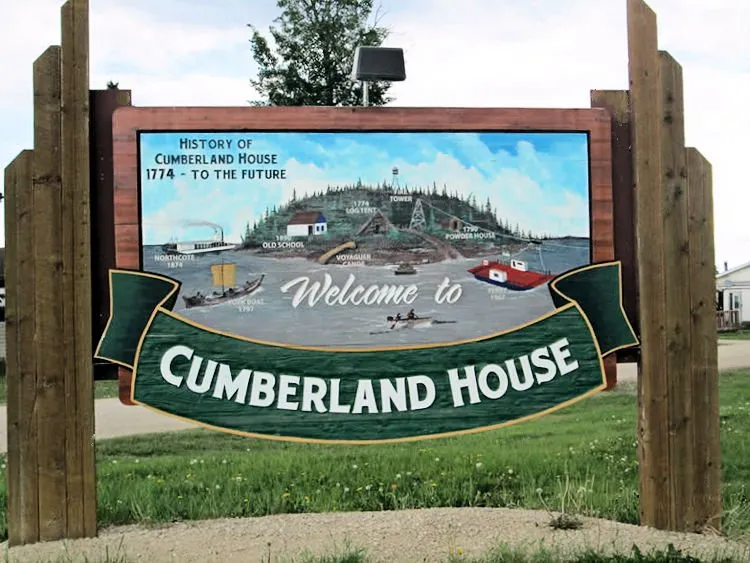
Cumberland House Welcome sign.
The village of Cumberland House is the oldest permanent settlement in Saskatchewan. While archeological finds indicate that North American Indians have inhabited the area for at least 6,000 years, the present settlement's location was established as a Hudson's Bay Company trading post and fort in 1774 by explorer Samuel Hearne. The importance of the Saskatchewan River as a major transportation route has influenced the history of the Cumberland House area and continues to influence community life today. The indigenous people travelled along the Saskatchewan up the Sturgeon Weir River system across Frog Portage and onto the Churchill River system. The Saskatchewan River was also used by the early fur traders representing the Hudson's Bay Company and its rival the Northwest Trading Company. From there they could access the Hudson Bay and Athabaska Basin and Arctic water sheds. Sternwheeler boats travelled the river from Grand Rapids to Edmonton until the late 1880's. The remains of one, the Northcote are on display at Cumberland House today. The Sternwheelers were taken out of service because of increasing competition from the railroads, low water levels, and the appearance of dangerous sand bars created by a major ice jam on the river in 1873. This ice jam resulted in the river overflowing its banks and eroding a new channel between the Saskatchewan and Torch Rivers. While this major natural event altered the course of the Saskatchewan River and helped spell doom for the sternwheelers, it also created new resources and opportunities for the residents of Cumberland and area. The present Cumberland delta and surrounding marshes provide an ideal habitat for moose and muskrat. Today the area yields the highest moose population per square kilometre in the province. The area also provides one of the largest nesting and staging areas for water fowl in North America. Today, the residents of Cumberland House continue to be dependent upon the river for transportation as a river ferry links the island-situated community with the provincial road system. (Erickson, 1983) Dave Smith - Flin Flon and "the line". The company knew where the line was between the two provinces. Many years ago they painted a yellow line around all the drifts [tunnels - BR]. At that time, Saskatchewan's compensation for injured workmen was slightly more lenient than the Manitoba one. So, if a fellow was hurt in Manitoba he would crawl, if he could, across this line and say he was hurt in Saskatchewan. 
Flin Flon Main Street looked like a swamp, which it was - a swamp. One day a fella - we used to wear high-topped boots to work - this was in 1931 - Anyway, this fella bet me two dollars he could cross the street and I won the two dollars. He couldn't cross the street. He got stuck in the mud. That's a fact. - Sam Hankin, Flin Flon merchant. 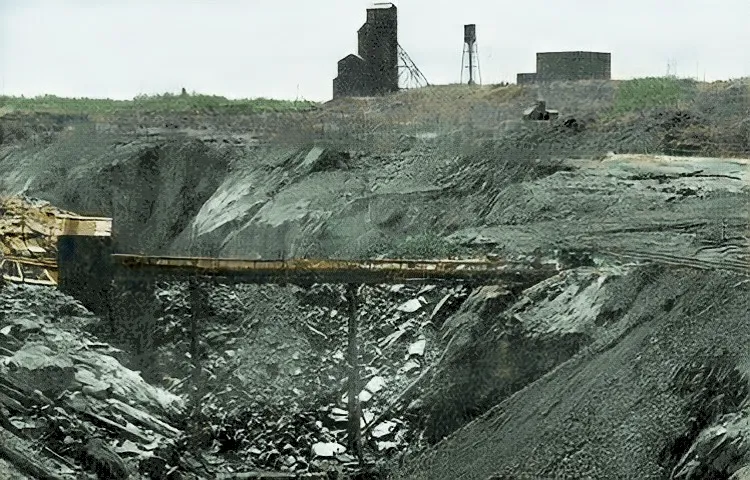
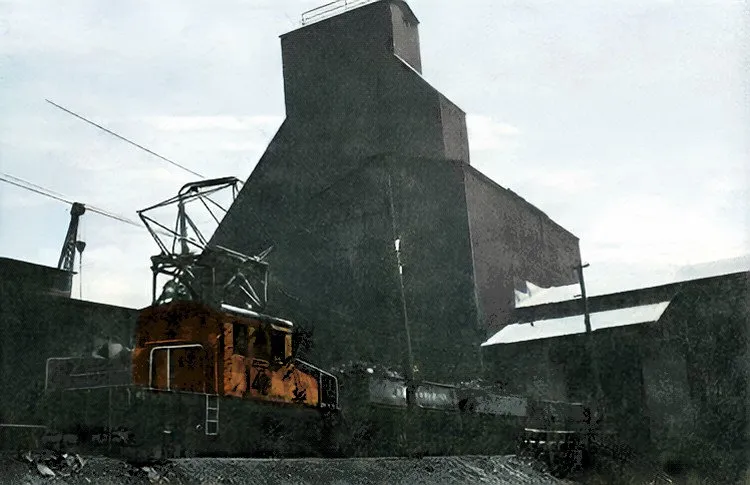
Credit: Saskatchewan Archives Board, Photograph no. RB 4959(1). THE CORONATION MINE. Gordon Bragg, a geologist with Hudson Bay Mining and Smelting, is Head of Exploration, Central Region. He was in charge of exploration for the company when the Coronation copper orebody was discovered in the Amisk Lake area. This was the orebody that Joe Brain claimed to have staked and allowed to lapse. 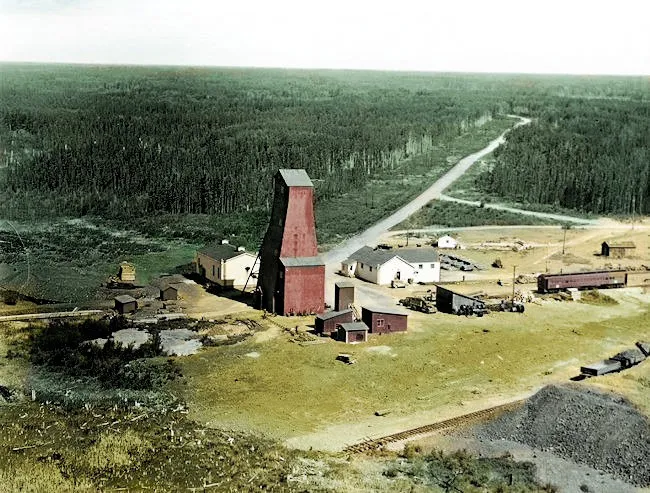
The Coronation Mine.
The most interesting areas are where we find ore bodies, in Saskatchewan, it was where we found the Coronation Mine. It was found in 1952, just two or three years after Hudson Bay got involved in the geophysically - oriented program of exploration. Using electrical and magnetic equipment instead of just geology and prospecting, it was one of the areas that looked favourable from a geological point of view. Hudson Bay had "blanketed" the ground by staking and was carrying out a rather routine program of investigation of electromagnetic "anomalies" disclosed by the old Boliden electromagnetic equipment. This was one of the last targets in this particular series, and we just happened to hit an orebody. There was no surface showing, but subsequently, we found it was only a matter of digging down a few feet to get into the copper mineralization. It was strictly a geophysical indication. There was a little bit of geochemical work done later, by Dr. Byers, of course, you got a chemical response because it was only a few feet down to rock. Now you can, on the walls of the open pit, see there was only a very minor amount of overburden. I was the diamond drill supervisor. I had a group of resident geologists in the area and I was supervising their role. I recall (but I'm a little reluctant to guarantee the details for posterity), that it was a major find, perhaps not a major one because it wasn't a big mine, only 1,400,000 tons. But, because it looked a lot bigger than some of the others, such as the Flexar and the Don Juan. The Flexar may have been found at that time, but not drilled off. It was so exciting that our chief geologist, Albert Koffman, took it upon himself to more or less supervise the operation, and I saw very little of it for several weeks. We were so worried about word getting out that we more or less closed the camp off. We wouldn't let drill crews move in or out. We tried to put a complete stop to all movement because we didn't know how much ground we needed to pick up. We didn't know whether we were going to find a series of ore bodies, so we wanted an opportunity to assess the find and make sure we had all we wanted in the way of ground control. There was so much secrecy; we were using rapid codes. Probably one of the more interesting features concerned the geologist we had on the job. He was a young fellow who had been out of school for only a couple of years. We'd get up a colour code for the description of mineralization, and in this particular case, we also told this fellow that if he found anything of importance, to order a transit. In the meantime, we forgot about having told him, so when it came over the radio that he wanted a transit I kept giving him a bad time. "What do you need a transit for?" Finally it dawned on us, that there was something there, so Albert Koffman flew out and sure enough, we had made a major hit. It is only about 15 miles southwest of Flin Flon. |
Questions - Comments?


Links to all jkcc.com Webpages:
| Ausland Lake |
Northern Saskatchewan
| Deep River Fur Farm |
| Deep River Trapping Page |
| Deep River Fishing Page |
| My Norwegian Roots |
| Aasland Farm, Norway |
| My Norwegian Family |
| Early Mink of People Canada |
E. Rendle Bowness
| The Manager's Tale |
Hugh McKay Ross
| Sakitawak Bi-Centennial |
200 Year History.
| Lost Land of the Caribou |
Ed Theriau
| A History of Buffalo Narrows |
| Hugh (Lefty) McLeod |
Bush Pilot
| George Greening |
Bush Pilot
| Timber Trails |
A History of Big River
| Joe Anstett, Trapper |
| Bill Windrum, Bush Pilot |
| Face the North Wind |
By Art Karas
| North to Cree Lake |
By Art Karas
| Look at the Past |
A History Dore Lake
| George Abbott |
A Family History
| These Are The Prairies |
| William A. A. Jay, Trapper |
| John Hedlund, Trapper |
| Deep River Photo Gallery |
| Cyril Mahoney, Trapper |
| Saskatchewan |
A Pictorial History
| Who's Who in furs |
1952 to 1956
| A Century in the Making |
A Big River History
| Wings Beyond Road's End |
| The Northern Trapper, 1923 |
| My Various Links Page |
| Ron Clancy, Author |
| Roman Catholic Church |
A History from 1849
| Frontier Characters - Ron Clancy |
| Northern Trader - Ron Clancy |
| Various Deep River Videos |
| How the Indians Used the Birch |
| The Great Fur Land |
| The Death of Albert Johnson |
| A Mink and Fish Story |
Buffalo Narrows
| Gold and Other Stories |
Berry Richards
| Saskatchewan James Carnegie |
| Ausland Lake |
Northern Saskatchewan
| Deep River Fur Farm |
| Deep River Trapping Page |
| Deep River Fishing Page |
| My Norwegian Roots |
| Aasland Farm, Norway |
| My Norwegian Family |
| Early Mink of People Canada |
E. Rendle Bowness
| The Manager's Tale |
Hugh McKay Ross
| Sakitawak Bi-Centennial |
200 Year History.
| Lost Land of the Caribou |
Ed Theriau
| A History of Buffalo Narrows |
| Hugh (Lefty) McLeod |
Bush Pilot
| George Greening |
Bush Pilot
| Timber Trails |
A History of Big River
| Joe Anstett, Trapper |
| Bill Windrum, Bush Pilot |
| Face the North Wind |
By Art Karas
| North to Cree Lake |
By Art Karas
| Look at the Past |
A History Dore Lake
| George Abbott |
A Family History
| These Are The Prairies |
| William A. A. Jay, Trapper |
| John Hedlund, Trapper |
| Deep River Photo Gallery |
| Cyril Mahoney, Trapper |
| Saskatchewan |
A Pictorial History
| Who's Who in furs |
1952 to 1956
| A Century in the Making |
A Big River History
| Wings Beyond Road's End |
| The Northern Trapper, 1923 |
| My Various Links Page |
| Ron Clancy, Author |
| Roman Catholic Church |
A History from 1849
| Frontier Characters - Ron Clancy |
| Northern Trader - Ron Clancy |
| Various Deep River Videos |
| How the Indians Used the Birch |
| The Great Fur Land |
| The Death of Albert Johnson |
| A Mink and Fish Story |
Buffalo Narrows
| Gold and Other Stories |
Berry Richards
| Saskatchewan James Carnegie |