
|
The heavy snow that came on the night that Fort Pitt fell soon melted and the glory of the North-west spring covered the land. How we joyed in those bright warm days, so full of light and promise if only this dreadful time should pass! The yellow grass of the old year, turning so quickly that one could almost see the change to brilliant green; the murmur of the creeks; the boom of rending ice; the straining of the buds in their sheaths; the twitter of the birds; the hum of insect life - all helped us to shake off the depression that had well-nigh overwhelmed us and to take a fresh interest in existence. Our captors, too, began to look with more friendly eyes upon us and our danger seemed to grow less. We obtained more freedom and wandered farther from the lodges. Came a day when guns were even loaned to Stanley Simpson and myself and we made occasional short hunting excursions in the afternoons with some of the Indians. Shortly after the Indians returned from Fort Pitt, the camp was moved two miles to a position commanding from flanking hills a view of the surrounding country, the camp itself being hidden by belts of spruce. An ambitious youth named The Wolf had contrived a buckboard out of two pairs of horse-rake wheels, the property of the Indian department, connected by a platform of boards nailed securely to the front and rear axles, on which he had mounted a soap-box seat. The maiden cruise of this ship of the wilderness forever blasted the aspirations of the designer to the role of a master of the carriage-builder's craft. Such a thing as a straight trail was unknown in the Frog Lake region, and with its rigid axles, his carriage would move in only two directions - straight ahead or straight back. The Wolf's first attempt to follow the trail furnished his friends much hilarity. His buckboard persisted in laying out a trail of its own, and when he swung his pony to the right the vehicle turned over on his head. The pony bolted. Later, The Wolf recovered the pony and the shafts. He had spent a whole week making his buckboard and got just five minutes' utility out of it. Our new camp was near Frog Lake. Huge blocks of crumbling ice from the lake were running in its channel and the Indians told us the stream was full of pike. Stanley Simpson and I got permission to go fishing. We drove down with Louis Patenaude to the ruins of the settlement. It was a month after the massacre and I had not visited the spot since that terrible day at the beginning of April. And what a change presented itself to me! Where was all the quiet, home-like charm of that beautiful landscape? There were the charred ruins of the buildings. Before what had been Delaney's house lay the head of poor Tom Quinn's little brown-and-white cocker, the dog he had been at such pains to train and whose clever tricks were his pride and delight. Death and desolation now. That was all. Among the ashes of the stables, we found the iron parts of some pitchforks and turned back to camp. Patenaude followed the trail down which Dill, my former partner, and Gilchrist had been chased and overhauled by the Indians on that fatal day, and in a slight hollow rimmed by wooded hills, lying in the middle of the trail, where he had been shot down beside his master, we came across Gilchrist's black-and-white dog. Off to the right in the grass beside the trees lay the bodies of the two men, left unburied by command of the Indians. Louis had pulled up close to them. It was a horrible sight. I held my breath. "For heaven's sake, Louis, drive on" I muttered. At the camp Simpson and I fixed poles in the pitchfork irons and went to the creek to spear fish. Discarding our shoes, and trousers rolled above our knees, we tramped up and down in the icy water. The shallows swarmed with pike. We drove them into corners, caught them on the forks and tossed them on the bank. Within an hour we had forty and returned to camp. Supper that night was a feast. While the pike is supposed to be somewhat flavourless, the change from a steady diet of beef was most agreeable. Louis had secured tea, sugar, rice and flour at Pitt and his wife made excellent bread. Let me attempt the difficult task of describing the Cree Grass or War Dance as I saw it day after day in Big Bear's camp: On a fine afternoon, Kahneepotaytayo, the head dancer or whipper-in, made the round of the lodges to summon the warriors to the dancing or soldiers' lodge, erected in each camp of three or four ordinary ones commandeered from their owners. The families so signalized for attention were presumed to regard the deprivation as an honour and sought shelter under their carts or in some adjacent bluff of poplar. Kahneepotaytayo is decked in all his finery. His limbs are bare but for the bands of fur about knees and elbows, and streaked with white mud. Broad bracelets of shining brass encircle his wrists. A crossbelt of bells hangs upon one shoulder and across his chest and smaller strings about his ankles jingle melodiously as he walks. He wears beaded moccasins, and about his hips and the upper parts of his muscular thighs is fixed his fancy breechcloth. The royal skin of a silver fox trails down his back. His eyes form the centre of stars from which radiate shafts of black and yellow paint. Sable bars alternate with the vermilion on his bronze cheeks, while from his mouth to his throat is perfect blackness. A bunch of jet-tipped eagle plumes bristles from behind his blue-black plaited hair. His hand grasps a staff one end of which is bound with beaded red cloth a sword and to the other more feathers. So much of the blade is covered that only a foot of it is visible. The drum begins its welling beat and the dancers assemble. They seat themselves in a circle inside the great dancing lodge, one end of which is open. The drum looks like a large wooden grain measure, the ends covered with parchment painted half black, half red. Around it sit the six drummers, beating a steady even beat and chanting the war song. Their faces wear a look of expectancy - the ceremony of Spearing the White Dog's Head is about to begin. Kahneepotaytayo and his understudy are seated a little apart. As the chant commences he rises and walks toward the centre of the circle. The woman appears carrying the huge copper pot in which the dog strangled for the occasion is still simmering. They set it down beside the centre pole and retire, for none but warriors may dance in the Grass Dance. Kahneepotaytayo kneels before the kettle, his understudy beside him. The chant is a weird and slow one. The palms of the chief actors are outspread on the hard smooth earth, their bodies thrown forward on them, their staffs planted in front. The chant rises, and to the rhythmic beat of the drum falls gradually until the lowest strain, a deep bass, is reached and dwelt upon. Thence it jumps abruptly to the shrill beginning, and again it falls, gradually, to the bass. Again it jumps to the treble, to sink once more - and again. See the painted and befeathered Kahneepotaytayol His lithe figure begins to sway, back and forth from side to side jn time with the chant and his palms to rub lightly the damp bare soil. He raises and brushes them softly together, muttering some incantation - for it is a religious ceremony - then drops and moves them over the earth again. The chant grows faster, changing to the Horse Song; he springs suddenly to his feet and begins to dance. His eyes flash. The thews and sinews of his limbs and chest stand out like ropes or roll and ripple beneath the smooth coppery skin like the coils of a moving snake. He circles about the White Dog's Head as though it were an enemy ready to strike should he approach too near - darts away with a shrill war cry, crouching along the ground, all the while keeping step to the measured pom! Pom! Pom! Pom! of the big drum and the wild plaintive voices of the drummers. His body leans and sways, pitches and glides, as he draws nearer to the kettle, with all the grace and agility of a panther stealing upon its prey. His companion is close behind, his shadow in the flesh, doubling his every motion. Sweat pours from their dark satin skins and glistens on their naked painted limbs and chests and faces. The eagle plumes on Kahneepotaytayo's head tossing with the twistings of his body. His eyes glow fiercely in the warm light. His face is set and drawn. He creeps nearer the kettle. He lifts his spear, and with a swift bound launches it at the head of the White Dog. The drum stops. He draws himself up, places his fingers over his lips and a long piercing staccato yell echoes through the camp. It is the coup - the death. He raises the kettle and carries it three times round in a circle. A roar of applause comes from the seated warriors and a volley rolls from the big drum. Then he walks over, takes Wandering Spirit by the wrist and conducts him to a seat upon a blanket set apart for the councillors and goes back for Four-Sky Thunder, Little Poplar and Nopahchass. These are first served from the kettle; afterward, it is passed to the other dancers and all give their attention to the feast - the food of warriors. The feasting over, dancing, in which all now join, is resumed. The drummers again start the Horse Song, echoing the steps of a horse at a smart trot. Kahneepotaytayo springs to his feet; he dances round the circle before the other dancers, spurring them with guttural cries of "Hy-aw-aw!" afoot, holding the whip he has exchanged for his sword threateningly over their heads. They rise as he passes and soon all are moving in a bewildering maze, shuffling along the ground bent double, turning suddenly as though attacked from behind, shouting shrill war cries and otherwise imitating their old habits and practices in time of war. Abruptly the drum stops and they walk back to their places to rest. When held at night the weird effect of the dance was heightened. Wandering Spirit was always conspicuous in the Grass Dance. Between the intervals of dancing it is customary for the distinguished warriors to "count their coups" - to tell off the scalps they have taken and the horses they have stolen from the enemy. One fine afternoon shortly after Fort Pitt, I listened to the war chief count his coups. It was in one of the intervals of rest. With a motion of his hand, he started the drummers. Leaping to his feet, he danced toward the drum, rifle in hand, crouching and wheeling, much as Kahneepotaytayo had done in spearing the Dog's Head. Brilliant paints covered his face and the plaits of his curling black hair were bound with strips of otter fur. He looked ferocious as he danced stealthily toward the booming drum, swinging his rifle now here, now there, retreating and advancing again. A small willow stick lay beside the drum. Presently he picked this up, crouched nearer and nearer and at length tossed it with a war whoop among the sticks of the drummers. The drumming ceased and the war chief drew himself up and began to speak. He numbered off the Blackfoot - eleven, I think - he had slain, pointing with his rifle in the direction of each successive exploit. "And then," he concluded, "there were another and another." (No names were mentioned, but he referred, I knew, to Indian Agent Quinn and Father Fafard). "How! Aywaik! Ahnis, N'keesaynewin! (So, That's something! I'm getting old, you see!") he added with a laugh. The dancing lodge is also the soldiers' lodge. The war chief was the head soldier or commander, and his followers were the soldiers. Such laws as were ordained for the regulation of the camp were enforced by the soldiers' lodge. Occasionally it became necessary to discipline refractory members of the band. One afternoon I was standing near the soldiers' lodge, watching the dance, when Oskatask, a Big Bear Indian, came down the trail close by. At a word from the war chief, Kahneepotaytayo and his assistant, knives in their hands, jumped to their feet, ran out, caught Oskatask by either arm and marched him into the dancing lodge. He was much older, bigger and more powerful than either of the young bucks, but beyond a sullen protest, he made no show of insubordination. He stood expostulating before the war chief, but his harangue had no effect upon Wandering Spirit. He sat with the face bf a sphinx and heard him to the end, while the young men stood with a hand on either shoulder of the speaker, their long naked blades in their other hands. Then Wandering Spirit gestured, and they turned and with the knives sliced the blanket coat of the prisoner to ribbons. Oskatask stood as if carved in stone. Had he stirred his flesh also would have been in ribbons. They released him then and he stalked away, his face black with smothered fury. He had killed cattle belonging to another Indian. This was his punishment. On another afternoon some time later the soldiers gave the camp a general shaking-up. Some of the warriors, apparently tired of the endless dancing, had disregarded the formal summons to the dancing lodge. I was standing before Patenaude's tent. I heard a chorus of yells and, looking up, saw the soldiers coming on the run around the wide circle enclosed by the camp. They carried knives and axes. They stopped before a lodge, and in a moment slashed it to shreds, while the inmates sat cowed and in no little danger as their habitation fell about their ears. Then the soldiers snatched furs and blankets from about their trembling owners and cut or tore them to bits in their teeth as they ran on to the next lodge singled out for discipline. In this way they destroyed in a few minutes no less than ten lodges, but the attendance at the dances was for some time materially improved. The soldiers stayed in the dancing lodge all night and took turns acting as guards to the camp, to prevent the escape of white prisoners and anticipate surprise by troops. When word was given to strike camp and march, a fair interval was allowed for compliance with the order. Then, Wandering Spirit leading, the soldiers marched around the camp and assisted the tardy ones in taking down their lodges. This they did by lifting the lodge bodily from over the heads of its inmates and laying it flat on the ground some distance away. At length the carts are packed and the caravan moves. One by one the carts fall into line, sending up a creaking chorus from the wooden axles audible miles away on the prairie until all have left camp. Up and down the long train ride the chiefs and head men, waking up the laggards and preserving order. Here rides Wandering Spirit on a tall gaunt grey mare taken from the Indian Department at Onion Lake, her flanks plentifully striped with white mud and her foretop and tail ornamented with tufts of feathers. 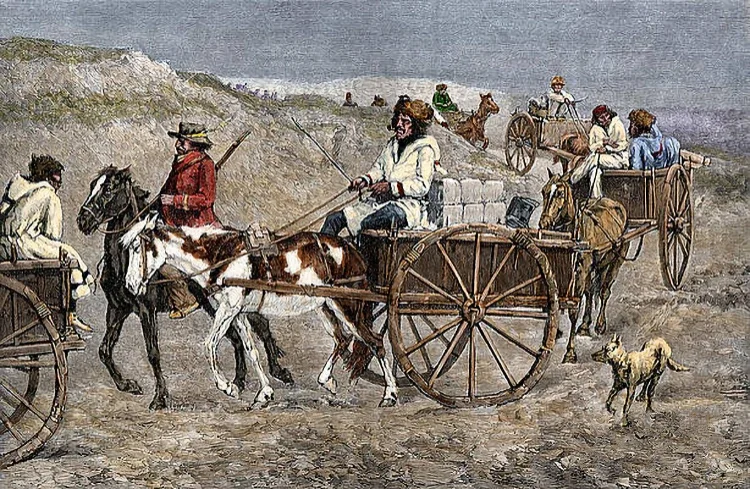
The war chief wears his lynx-skin cap, a whole skin, head fixed to tail, open at the top, making a huge double loop of long grey fur. The five eagle plumes, for each of which he boasts he means to have a white man's scalp, float above the cap. Thrown loosely about his shoulders is his long blue-and-white blanket coat. Green cloth leggings cover his legs and beaded moccasins his feet. His sheath knife shows in his belt of yellow cartridges. His right hand holds lightly the slack bridle-rein and in the crook of his left arm rests his Winchester - the rifle commandeered from Henry Quinn at Pitt. Young bucks, two on a pony, dash in and out through the line, followed by the imprecations of old wrinkled women, toiling painfully along with bent shoulders, dragging by cords dejected-looking curs which are also beasts of burden and pull travois. Some are hunting ducks and rabbits among the numerous bluffs and lakes along the route. Seated in the carts on rolls of bedding, teepees, lodge poles, boxes and provisions are the squaws, and papooses embracing the inevitable family puppies. Here goes another old woman, leading a pony with; travois - a contrivance formed of two poles lashed together near their tops, the angle thus engineered resting across the pony's back, the butts dragging on the ground in the rear. Behind the horse and a couple of feet from the earth, the load is fixed - blackened kettles and pans, with perhaps an infant in a moss bag filling the biggest of the kettles. Here a young and pretty squaw perches above the travois, astride the pony's back. Or perhaps her feet are crossed on the ample seat, like a Turk's. The half-naked boys are scattered along the train, yelling and shooting arrows to keep the loose animals up and the caravan in motion. Now a cart collapses and the line comes together like an accordion. An old woman ties her dog by the leading cord to the wheel of the cart in front and shambles off to a seat under a bluff to rest and smoke. Presently the line starts again. The ancient crone tumbles forward shrilling "Tesqua! Tesqua!" at the top of her cracked old voice. Her dog is being hanged on his leading line by the great revolving wooden wheel. But suddenly the flimsy cord breaks and he comes down with a clatter among his load of kettles and pans and howling terrified infant. The long train stretches out once more. Guns flash, riders gallop furiously here and there, blankets toss, cattle bawl, axles creak, dust rises, shouts and imprecations swell the din, until out of disorder comes order. The march is underway once more. A halt is made at noon, the kettle is boiled for tea and the animals are loosed to feed on the rich grass. Then the march is resumed and goes on till evening. The lodges are pitched in a great circle, each with its campfire, and the dancing lodge near the centre. Night and darkness fall, but not silence. The drum booms from the red walls of the dancing lodge, the sneaking dogs snarl and scuffle over the scraps tossed from the tents, and perhaps a shot goes off by accident sending a hard chilling note through the camp's drowsy voices. Four-Sky Thunder, pain killer drugged, trolls tipsily in a nearby lodge. From another, the sound of a gambling song rises. The half-Blackfoot chief stalks through the camp, crying his dolorous wailing chant because there is bad blood between the bands. He is trying to exorcise the devils that have caused it. 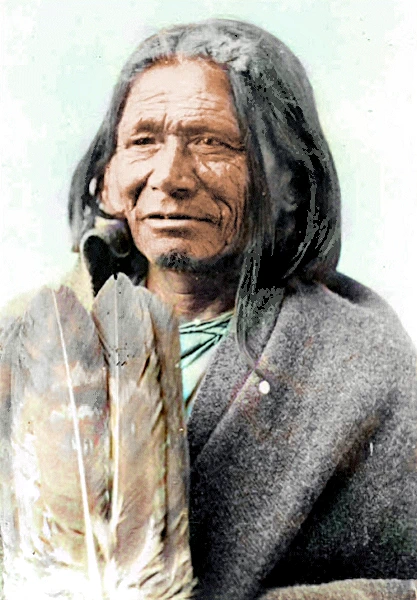
Wearied, I at length drop into a troubled sleep. But suddenly I find myself bolt upright on my blanket. My heart is beating not at all. But presently it starts again, very slowly, the halted blood resumes its flow and I fall back and close my eyes once more. A horse has stumbled against the taut guy-ropes of the lodge, that is all, and they snap like whips in my startled ear. But it might have been a painted man, entering stealthily with a knife in his teeth and murder in his heart. |
Questions - Comments?


Links to all jkcc.com Webpages:
| Ausland Lake |
Northern Saskatchewan
| Deep River Fur Farm |
| Deep River Trapping Page |
| Deep River Fishing Page |
| My Norwegian Roots |
| Aasland Farm, Norway |
| My Norwegian Family |
| Early Mink of People Canada |
E. Rendle Bowness
| The Manager's Tale |
Hugh McKay Ross
| Sakitawak Bi-Centennial |
200 Year History.
| Lost Land of the Caribou |
Ed Theriau
| A History of Buffalo Narrows |
| Hugh (Lefty) McLeod |
Bush Pilot
| George Greening |
Bush Pilot
| Timber Trails |
A History of Big River
| Joe Anstett, Trapper |
| Bill Windrum, Bush Pilot |
| Face the North Wind |
By Art Karas
| North to Cree Lake |
By Art Karas
| Look at the Past |
A History Dore Lake
| George Abbott |
A Family History
| These Are The Prairies |
| William A. A. Jay, Trapper |
| John Hedlund, Trapper |
| Deep River Photo Gallery |
| Cyril Mahoney, Trapper |
| Saskatchewan |
A Pictorial History
| Who's Who in furs |
1952 to 1956
| A Century in the Making |
A Big River History
| Wings Beyond Road's End |
| The Northern Trapper, 1923 |
| My Various Links Page |
| Ron Clancy, Author |
| Roman Catholic Church |
A History from 1849
| Frontier Characters - Ron Clancy |
| Northern Trader - Ron Clancy |
| Various Deep River Videos |
| How the Indians Used the Birch |
| The Great Fur Land |
| The Death of Albert Johnson |
| A Mink and Fish Story |
Buffalo Narrows
| Gold and Other Stories |
Berry Richards
| Saskatchewan James Carnegie |
| Ausland Lake |
Northern Saskatchewan
| Deep River Fur Farm |
| Deep River Trapping Page |
| Deep River Fishing Page |
| My Norwegian Roots |
| Aasland Farm, Norway |
| My Norwegian Family |
| Early Mink of People Canada |
E. Rendle Bowness
| The Manager's Tale |
Hugh McKay Ross
| Sakitawak Bi-Centennial |
200 Year History.
| Lost Land of the Caribou |
Ed Theriau
| A History of Buffalo Narrows |
| Hugh (Lefty) McLeod |
Bush Pilot
| George Greening |
Bush Pilot
| Timber Trails |
A History of Big River
| Joe Anstett, Trapper |
| Bill Windrum, Bush Pilot |
| Face the North Wind |
By Art Karas
| North to Cree Lake |
By Art Karas
| Look at the Past |
A History Dore Lake
| George Abbott |
A Family History
| These Are The Prairies |
| William A. A. Jay, Trapper |
| John Hedlund, Trapper |
| Deep River Photo Gallery |
| Cyril Mahoney, Trapper |
| Saskatchewan |
A Pictorial History
| Who's Who in furs |
1952 to 1956
| A Century in the Making |
A Big River History
| Wings Beyond Road's End |
| The Northern Trapper, 1923 |
| My Various Links Page |
| Ron Clancy, Author |
| Roman Catholic Church |
A History from 1849
| Frontier Characters - Ron Clancy |
| Northern Trader - Ron Clancy |
| Various Deep River Videos |
| How the Indians Used the Birch |
| The Great Fur Land |
| The Death of Albert Johnson |
| A Mink and Fish Story |
Buffalo Narrows
| Gold and Other Stories |
Berry Richards
| Saskatchewan James Carnegie |